ini
13 lines · 1 tab
Kai Nakamura
Apr 2026
1 tab
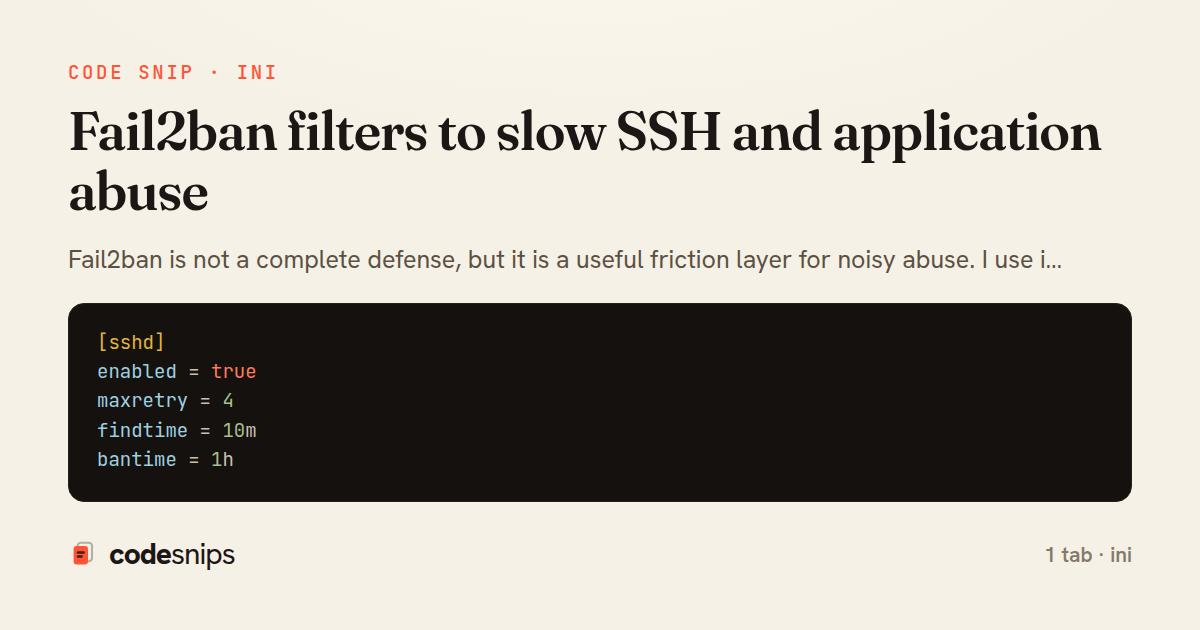
[sshd]
enabled = true
maxretry = 4
findtime = 10m
bantime = 1h

[nginx-auth]
enabled = true
port = http,https
logpath = /var/log/nginx/error.log
maxretry = 10
findtime = 5m
bantime = 30m
1 file · ini
Explain with highlit
Fail2ban is not a complete defense, but it is a useful friction layer for noisy abuse. I use it where login failures or repeated 401s clearly indicate hostile automation. It works best when paired with centralized logs and upstream rate limiting, not as a magical perimeter shield.
Related snips
python
import os
import stat

for root, _dirs, files in os.walk('/etc'):
    for name in files:
        path = os.path.join(root, name)
Python security audit script for exposed risky filesystem state
python
auditing
host-security
by Kai Nakamura
1 tab
plaintext
Protocol 2
PermitRootLogin no
PasswordAuthentication no
KbdInteractiveAuthentication no
PubkeyAuthentication yes
AllowUsers deploy ops
SSH daemon hardening and key based access only
ssh
linux
hardening
by Kai Nakamura
1 tab
ruby
class Rack::Attack
  throttle('logins/ip', limit: 5, period: 20.seconds) do |request|
    request.ip if request.path == '/users/sign_in' && request.post?
  end

  throttle('password_reset/email', limit: 3, period: 15.minutes) do |request|
Rate limiting abusive clients with Rack::Attack
rate-limiting
rack-attack
brute-force
by Kai Nakamura
1 tab
php
<?php

declare(strict_types=1);

namespace App\Security;
PHP Login Rate Limiting with a Sliding-Window Throttle Middleware
php
rate-limiting
middleware
by codesnips
3 tabs
Share this code
Here's the card — post it anywhere.