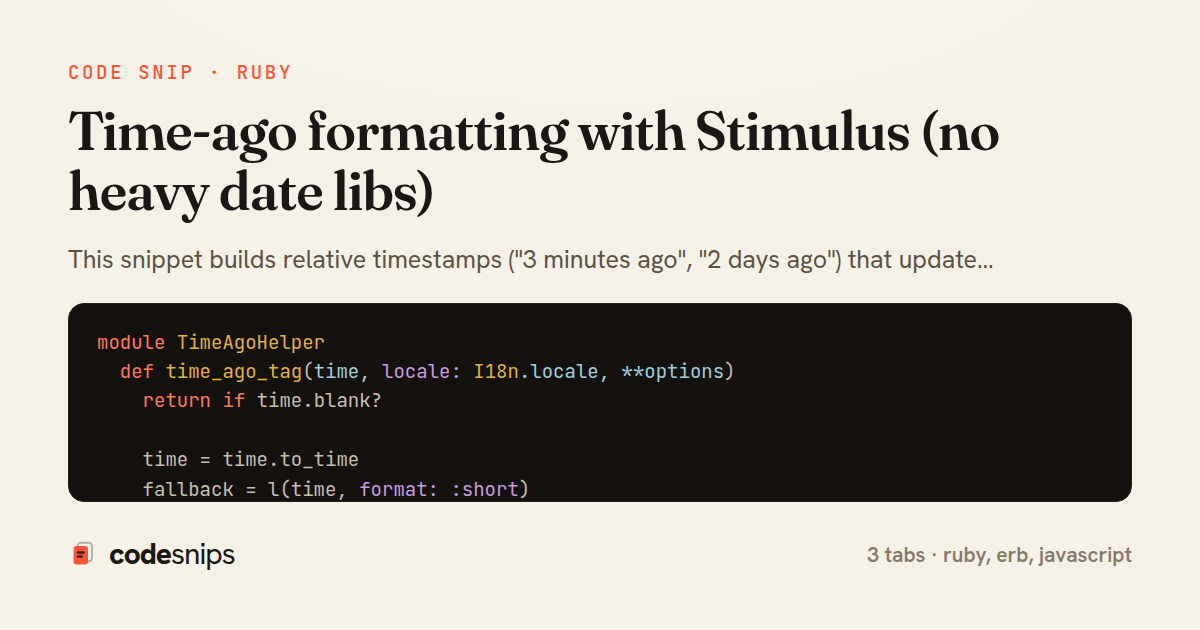
module TimeAgoHelper
  def time_ago_tag(time, locale: I18n.locale, **options)
    return if time.blank?

    time = time.to_time
    fallback = l(time, format: :short)

    content_tag(
      :time,
      fallback,
      datetime: time.iso8601,
      title: l(time, format: :long),
      data: {
        controller: "time-ago",
        time_ago_datetime_value: time.iso8601,
        time_ago_locale_value: locale.to_s
      },
      **options
    )
  end
end
<article class="comment" id="<%= dom_id(comment) %>">
  <header class="comment__meta">
    <%= image_tag comment.author.avatar_url, class: "comment__avatar", alt: "" %>
    <span class="comment__author"><%= comment.author.name %></span>

    <%# The <time> renders a static date, then Stimulus makes it live. %>
    <%= time_ago_tag comment.created_at, class: "comment__timestamp" %>
  </header>

  <div class="comment__body">
    <%= sanitize comment.body_html %>
  </div>

  <% if policy(comment).edit? %>
    <%= link_to "Edit", edit_comment_path(comment), class: "comment__edit" %>
  <% end %>
</article>
import { Controller } from "@hotwired/stimulus"

const DIVISIONS = [
  { amount: 60, unit: "second" },
  { amount: 60, unit: "minute" },
  { amount: 24, unit: "hour" },
  { amount: 7, unit: "day" },
  { amount: 4.34524, unit: "week" },
  { amount: 12, unit: "month" },
  { amount: Number.POSITIVE_INFINITY, unit: "year" }
]

export default class extends Controller {
  static values = { datetime: String, locale: { type: String, default: "en" } }

  connect() {
    this.formatter = new Intl.RelativeTimeFormat(this.localeValue, { numeric: "auto" })
    this.date = new Date(this.datetimeValue)
    this.refresh()
  }

  disconnect() {
    if (this.timer) clearTimeout(this.timer)
  }

  refresh() {
    this.element.textContent = this.format()
    this.scheduleNext()
  }

  format() {
    let delta = Math.min((this.date.getTime() - Date.now()) / 1000, 0)

    for (const division of DIVISIONS) {
      if (Math.abs(delta) < division.amount) {
        return this.formatter.format(Math.round(delta), division.unit)
      }
      delta /= division.amount
    }
  }

  scheduleNext() {
    const ageSeconds = (Date.now() - this.date.getTime()) / 1000
    if (ageSeconds > 86400) return // older than a day: stop ticking

    const cadence = ageSeconds < 60 ? 5000 : 60000
    this.timer = setTimeout(() => this.refresh(), cadence)
  }
}
This snippet builds relative timestamps ("3 minutes ago", "2 days ago") that update themselves in the browser without pulling in Moment.js or date-fns. The whole thing leans on Intl.RelativeTimeFormat, a native browser API that handles locale-aware pluralization and phrasing for free, so the client-side footprint stays near zero.
The time_ago_tag helper renders a semantic <time> element with a machine-readable datetime attribute in ISO 8601. That attribute is the single source of truth: the server never guesses what "ago" means at render time, it just emits the absolute instant. The element carries data-controller="time-ago" and a data-time-ago-datetime-value so the Stimulus controller can hydrate it. Crucially, the tag also renders a human-readable fallback inside the element, so if JavaScript is disabled or slow the reader still sees a real date — this is progressive enhancement rather than a blank node.
In time_ago_controller.js, the datetimeValue typed value auto-parses the ISO string into a Date. On connect() the controller renders once and then starts an interval. The refresh() method computes the delta and calls format(), which walks a small table of thresholds (minute, hour, day, week, month, year) and picks the largest unit that fits, passing a negative value to RelativeTimeFormat so the API produces past-tense phrasing.
Two details make it production-safe. The interval cadence adapts in scheduleNext(): very recent times refresh every few seconds, older ones every minute, and anything past a day stops ticking entirely since "5 days ago" does not need per-second churn. And disconnect() clears the timer, which matters under Turbo where controllers connect and disconnect as frames swap — without cleanup, orphaned intervals would leak and multiply.
The controller also sets the element's title to the full localized timestamp so hovering reveals the exact time, keeping both quick-scan and precise readings available. The trade-off is that clock skew between server and client can make brand-new items read as "in a few seconds"; the Math.min(delta, 0) guard clamps that so future-ish drift still shows "just now" rather than a confusing future phrase.
Related snips
class CommentsController < ApplicationController
  before_action :set_post

  def create
    @comment = @post.comments.build(comment_params)
System test: asserting Turbo Stream responses
class Post < ApplicationRecord
  belongs_to :author, class_name: 'User'
  has_many :comments, dependent: :destroy

  scope :published, -> { where.not(published_at: nil).where('published_at <= ?', Time.current) }
  scope :draft, -> { where(published_at: nil) }
ActiveRecord scopes for reusable query logic
module Api
  module V1
    class UsersController < BaseController
      def show
        user = User.includes(:profile).find(params[:id])
ETags for conditional requests and caching
class PostsController < ApplicationController
  def index
    @posts = Post.includes(:author)
                 .order(created_at: :desc)
                 .page(params[:page])
                 .per(10)
Turbo Frames: infinite scroll with lazy-loading frame
<!DOCTYPE html>
<html lang="en">
<head>
  <meta charset="UTF-8">
  <meta name="viewport" content="width=device-width, initial-scale=1.0">
  <title>Semantic HTML Example</title>
Semantic HTML5 elements and accessibility best practices
require "csv"

class PeopleCsvStream
  include Enumerable

  HEADERS = %w[id full_name email signed_up_at plan].freeze
Resilient CSV Export as a Streamed Response
Share this code
Here's the card — post it anywhere.