python
33 lines · 2 tabs
Priya Sharma
Jan 2026
2 tabs
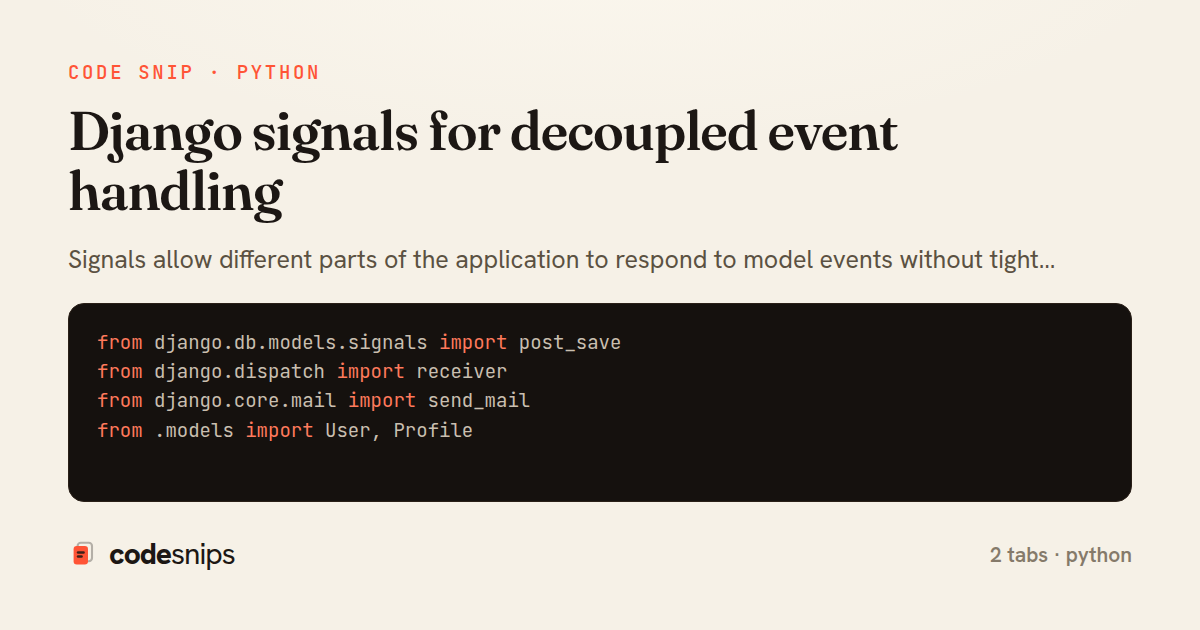
from django.db.models.signals import post_save
from django.dispatch import receiver
from django.core.mail import send_mail
from .models import User, Profile


@receiver(post_save, sender=User)
def create_user_profile(sender, instance, created, **kwargs):
    """Create a profile automatically when a user is created."""
    if created:
        Profile.objects.create(user=instance)


@receiver(post_save, sender=User)
def send_welcome_email(sender, instance, created, **kwargs):
    """Send welcome email to new users."""
    if created:
        send_mail(
            subject='Welcome to our platform!',
            message=f'Hi {instance.first_name}, welcome aboard!',
            from_email='noreply@example.com',
            recipient_list=[instance.email],
            fail_silently=True,
        )
from django.apps import AppConfig


class AccountsConfig(AppConfig):
    default_auto_field = 'django.db.models.BigAutoField'
    name = 'accounts'

    def ready(self):
        import accounts.signals  # noqa
2 files · python
Explain with highlit
Signals allow different parts of the application to respond to model events without tight coupling. I use post_save for actions after an object is created or updated, like sending notifications or updating related records. The @receiver decorator is cleaner than connect() calls. I'm careful to check created flag to distinguish creation from updates. For heavy operations, I dispatch to Celery tasks instead of blocking the request. Signals are powerful but can make code harder to trace, so I document them well and use sparingly for cross-app coordination.
Related snips
python
import os
import stat

for root, _dirs, files in os.walk('/etc'):
    for name in files:
        path = os.path.join(root, name)
Python security audit script for exposed risky filesystem state
python
auditing
host-security
by Kai Nakamura
1 tab
python
class Product(models.Model):
    name = models.CharField(max_length=200)
    slug = models.SlugField(blank=True)
    price = models.DecimalField(max_digits=10, decimal_places=2)
    cost = models.DecimalField(max_digits=10, decimal_places=2)
    margin = models.DecimalField(max_digits=5, decimal_places=2, blank=True)
Django model signals vs overriding save
django
python
models
by Priya Sharma
2 tabs
python
from django.urls import path
from . import views

app_name = 'blog'

urlpatterns = [
Django URL namespacing and reverse lookups
django
python
urls
by Priya Sharma
3 tabs
python
import graphene
from graphene_django import DjangoObjectType
from blog.models import Post, Comment


class PostType(DjangoObjectType):
Django GraphQL with Graphene
django
python
graphql
by Priya Sharma
2 tabs
python
from django.db.models import Count, Avg, Sum, Q, F
from django.views.generic import TemplateView
from products.models import Product, Order, OrderItem


class DashboardView(TemplateView):
Django aggregation with annotate for statistics
django
python
database
by Priya Sharma
1 tab
python
from rest_framework import permissions


class IsOwner(permissions.BasePermission):
    """Allow only object owner to access."""
Django REST Framework permissions and authorization
django
python
rest
by Priya Sharma
2 tabs
Share this code
Here's the card — post it anywhere.