python
30 lines · 2 tabs
Priya Sharma
Jan 2026
2 tabs
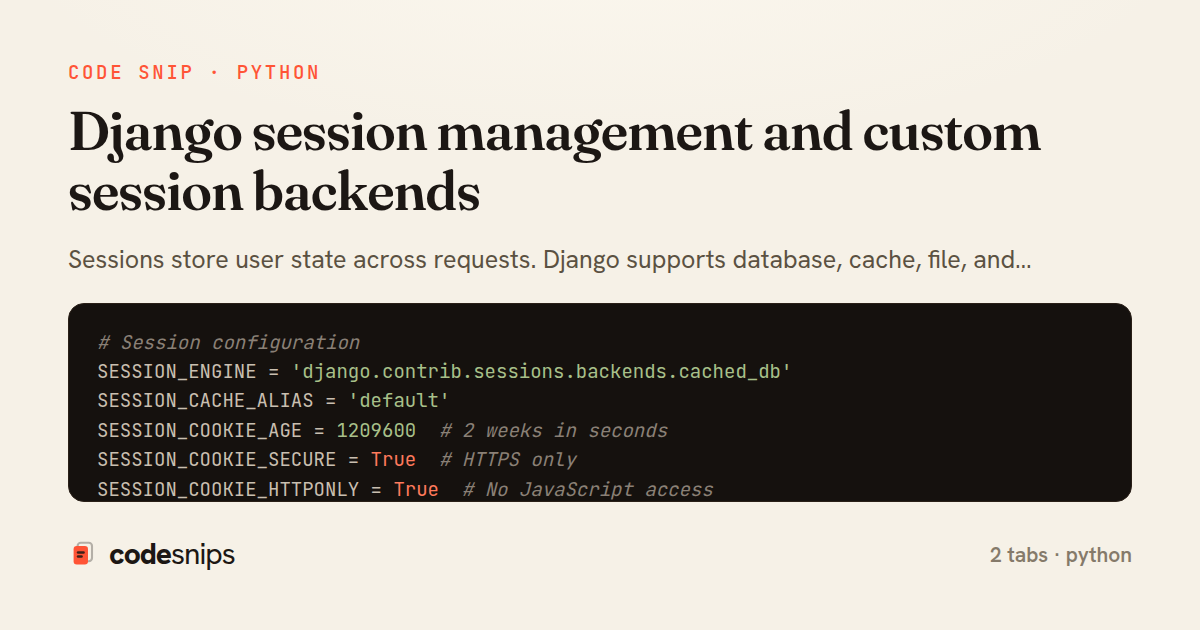
# Session configuration
SESSION_ENGINE = 'django.contrib.sessions.backends.cached_db'
SESSION_CACHE_ALIAS = 'default'
SESSION_COOKIE_AGE = 1209600  # 2 weeks in seconds
SESSION_COOKIE_SECURE = True  # HTTPS only
SESSION_COOKIE_HTTPONLY = True  # No JavaScript access
SESSION_COOKIE_SAMESITE = 'Lax'
SESSION_SAVE_EVERY_REQUEST = False  # Only save if modified
def add_to_cart(request, product_id):
    cart = request.session.get('cart', {})
    cart[str(product_id)] = cart.get(str(product_id), 0) + 1
    request.session['cart'] = cart
    request.session.modified = True  # Force save
    return redirect('cart:view')


def set_session_expiry(request):
    # Expire when browser closes
    request.session.set_expiry(0)

    # Expire in 5 minutes
    request.session.set_expiry(300)

    # Expire at specific datetime
    from datetime import datetime, timedelta
    request.session.set_expiry(datetime.now() + timedelta(hours=1))


def clear_session(request):
    request.session.flush()  # Delete session and create new one
2 files · python
Explain with highlit
Sessions store user state across requests. Django supports database, cache, file, and cookie-based sessions. I use cacheddb for read performance with database persistence. For APIs, I avoid sessions in favor of token auth. The request.session dict-like object stores arbitrary data. I set expiry with `setexpiry(). For security, I useSESSIONCOOKIESECUREandSESSIONCOOKIEHTTPONLY` in production. Custom session backends can store sessions in Redis or other stores. This enables features like shopping carts and multi-step forms.
Related snips
python
import os
import stat

for root, _dirs, files in os.walk('/etc'):
    for name in files:
        path = os.path.join(root, name)
Python security audit script for exposed risky filesystem state
python
auditing
host-security
by Kai Nakamura
1 tab
python
class Product(models.Model):
    name = models.CharField(max_length=200)
    slug = models.SlugField(blank=True)
    price = models.DecimalField(max_digits=10, decimal_places=2)
    cost = models.DecimalField(max_digits=10, decimal_places=2)
    margin = models.DecimalField(max_digits=5, decimal_places=2, blank=True)
Django model signals vs overriding save
django
python
models
by Priya Sharma
2 tabs
python
from django.urls import path
from . import views

app_name = 'blog'

urlpatterns = [
Django URL namespacing and reverse lookups
django
python
urls
by Priya Sharma
3 tabs
typescript
import { randomBytes, createHash } from "crypto";
import jwt from "jsonwebtoken";
import { RefreshTokenStore } from "./store";

const ACCESS_SECRET = process.env.ACCESS_SECRET!;
const ACCESS_TTL = "15m";
JWT access + refresh token rotation (conceptual)
security
node
jwt
by codesnips
3 tabs
python
import graphene
from graphene_django import DjangoObjectType
from blog.models import Post, Comment


class PostType(DjangoObjectType):
Django GraphQL with Graphene
django
python
graphql
by Priya Sharma
2 tabs
python
from django.db.models import Count, Avg, Sum, Q, F
from django.views.generic import TemplateView
from products.models import Product, Order, OrderItem


class DashboardView(TemplateView):
Django aggregation with annotate for statistics
django
python
database
by Priya Sharma
1 tab
Share this code
Here's the card — post it anywhere.