python
49 lines · 1 tab
Priya Sharma
Jan 2026
1 tab
import csv
from django.http import StreamingHttpResponse, FileResponse


class Echo:
    """Helper for writing to streaming response."""
    def write(self, value):
        return value


def export_large_csv(request):
    """Stream large CSV without loading all data in memory."""

    def generate_rows():
        """Generator yielding CSV rows."""
        from products.models import Product

        # Yield header
        yield ['ID', 'Name', 'Price', 'Stock']

        # Stream products in chunks
        for product in Product.objects.iterator(chunk_size=1000):
            yield [
                str(product.id),
                product.name,
                str(product.price),
                str(product.stock)
            ]

    pseudo_buffer = Echo()
    writer = csv.writer(pseudo_buffer)
    rows = (writer.writerow(row) for row in generate_rows())

    response = StreamingHttpResponse(
        rows,
        content_type='text/csv'
    )
    response['Content-Disposition'] = 'attachment; filename="products.csv"'
    return response


def download_file(request, file_path):
    """Serve file download efficiently."""
    response = FileResponse(
        open(file_path, 'rb'),
        content_type='application/octet-stream'
    )
    response['Content-Disposition'] = f'attachment; filename="{os.path.basename(file_path)}"'
    return response
1 file · python
Explain with highlit
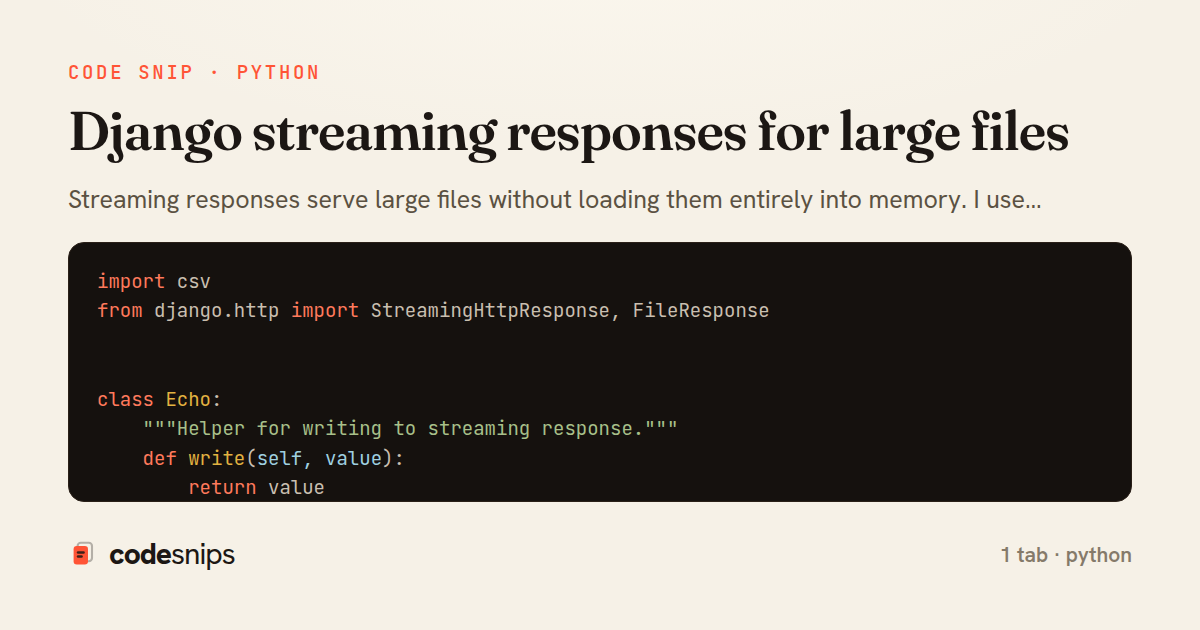
Streaming responses serve large files without loading them entirely into memory. I use StreamingHttpResponse or FileResponse for file downloads. For CSV generation, I yield rows incrementally. The generator pattern keeps memory usage constant regardless of file size. I set appropriate content-type and content-disposition headers. For video streaming, I implement range request support. This enables serving large datasets or media files efficiently without server memory limits.
Related snips
python
import os
import stat

for root, _dirs, files in os.walk('/etc'):
    for name in files:
        path = os.path.join(root, name)
Python security audit script for exposed risky filesystem state
python
auditing
host-security
by Kai Nakamura
1 tab
python
class Product(models.Model):
    name = models.CharField(max_length=200)
    slug = models.SlugField(blank=True)
    price = models.DecimalField(max_digits=10, decimal_places=2)
    cost = models.DecimalField(max_digits=10, decimal_places=2)
    margin = models.DecimalField(max_digits=5, decimal_places=2, blank=True)
Django model signals vs overriding save
django
python
models
by Priya Sharma
2 tabs
ruby
require "csv"

class PeopleCsvStream
  include Enumerable

  HEADERS = %w[id full_name email signed_up_at plan].freeze
Resilient CSV Export as a Streamed Response
rails
performance
streaming
by codesnips
3 tabs
python
from django.urls import path
from . import views

app_name = 'blog'

urlpatterns = [
Django URL namespacing and reverse lookups
django
python
urls
by Priya Sharma
3 tabs
python
import graphene
from graphene_django import DjangoObjectType
from blog.models import Post, Comment


class PostType(DjangoObjectType):
Django GraphQL with Graphene
django
python
graphql
by Priya Sharma
2 tabs
python
from django.db.models import Count, Avg, Sum, Q, F
from django.views.generic import TemplateView
from products.models import Product, Order, OrderItem


class DashboardView(TemplateView):
Django aggregation with annotate for statistics
django
python
database
by Priya Sharma
1 tab
Share this code
Here's the card — post it anywhere.