python
50 lines · 2 tabs
Priya Sharma
Jan 2026
2 tabs
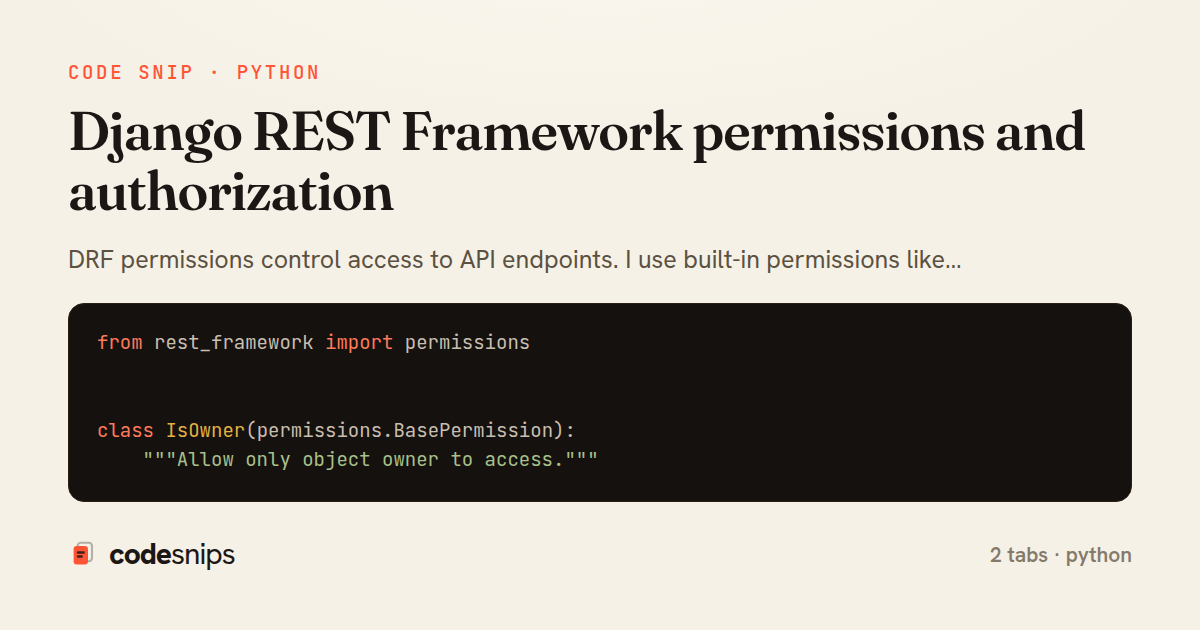
from rest_framework import permissions


class IsOwner(permissions.BasePermission):
    """Allow only object owner to access."""

    def has_object_permission(self, request, view, obj):
        return obj.owner == request.user


class IsAdminOrReadOnly(permissions.BasePermission):
    """Admins can edit, others read-only."""

    def has_permission(self, request, view):
        if request.method in permissions.SAFE_METHODS:
            return True
        return request.user and request.user.is_staff


class HasAPIKey(permissions.BasePermission):
    """Require valid API key in header."""

    def has_permission(self, request, view):
        api_key = request.META.get('HTTP_X_API_KEY')
        if not api_key:
            return False

        from api.models import APIKey
        return APIKey.objects.filter(key=api_key, is_active=True).exists()
from rest_framework import viewsets
from rest_framework.permissions import IsAuthenticated


class PostViewSet(viewsets.ModelViewSet):
    queryset = Post.objects.all()
    serializer_class = PostSerializer

    def get_permissions(self):
        """Different permissions per action."""
        if self.action == 'list':
            permission_classes = [permissions.AllowAny]
        elif self.action == 'create':
            permission_classes = [IsAuthenticated]
        else:
            permission_classes = [IsAuthenticated, IsOwner]
        return [permission() for permission in permission_classes]


class AdminViewSet(viewsets.ModelViewSet):
    permission_classes = [IsAuthenticated, IsAdminOrReadOnly, HasAPIKey]
2 files · python
Explain with highlit
DRF permissions control access to API endpoints. I use built-in permissions like IsAuthenticated, IsAdminUser, or IsAuthenticatedOrReadOnly. For custom logic, I create permission classes implementing has_permission() and has_object_permission(). I combine multiple permissions with lists. Permissions run before views, short-circuiting unauthorized requests. For object-level permissions, I check ownership or roles. I use different permissions per action with get_permissions(). This provides fine-grained API access control separate from Django's auth system.
Related snips
python
import os
import stat

for root, _dirs, files in os.walk('/etc'):
    for name in files:
        path = os.path.join(root, name)
Python security audit script for exposed risky filesystem state
python
auditing
host-security
by Kai Nakamura
1 tab
python
class Product(models.Model):
    name = models.CharField(max_length=200)
    slug = models.SlugField(blank=True)
    price = models.DecimalField(max_digits=10, decimal_places=2)
    cost = models.DecimalField(max_digits=10, decimal_places=2)
    margin = models.DecimalField(max_digits=5, decimal_places=2, blank=True)
Django model signals vs overriding save
django
python
models
by Priya Sharma
2 tabs
python
from django.urls import path
from . import views

app_name = 'blog'

urlpatterns = [
Django URL namespacing and reverse lookups
django
python
urls
by Priya Sharma
3 tabs
python
import graphene
from graphene_django import DjangoObjectType
from blog.models import Post, Comment


class PostType(DjangoObjectType):
Django GraphQL with Graphene
django
python
graphql
by Priya Sharma
2 tabs
python
from django.db.models import Count, Avg, Sum, Q, F
from django.views.generic import TemplateView
from products.models import Product, Order, OrderItem


class DashboardView(TemplateView):
Django aggregation with annotate for statistics
django
python
database
by Priya Sharma
1 tab
python
from django.db import models
from django.utils.text import slugify


class Article(models.Model):
    title = models.CharField(max_length=200)
Django model save override for custom logic
django
python
models
by Priya Sharma
1 tab
Share this code
Here's the card — post it anywhere.