python
48 lines · 3 tabs
Priya Sharma
Jan 2026
3 tabs
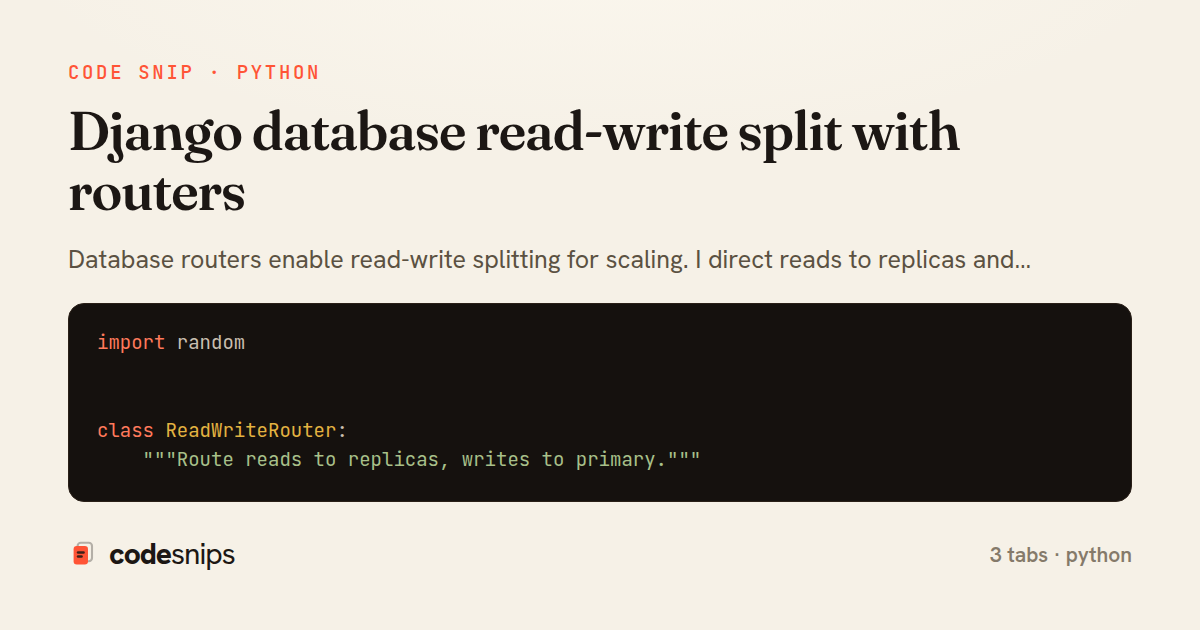
import random


class ReadWriteRouter:
    """Route reads to replicas, writes to primary."""

    def db_for_read(self, model, **hints):
        """Send reads to random replica."""
        return random.choice(['replica1', 'replica2'])

    def db_for_write(self, model, **hints):
        """Send all writes to primary."""
        return 'default'

    def allow_relation(self, obj1, obj2, **hints):
        """Allow relations between objects in same database."""
        db_set = {'default', 'replica1', 'replica2'}
        if obj1._state.db in db_set and obj2._state.db in db_set:
            return True
        return None

    def allow_migrate(self, db, app_label, model_name=None, **hints):
        """Only run migrations on primary."""
        return db == 'default'
DATABASES = {
    'default': {  # Primary for writes
        'ENGINE': 'django.db.backends.postgresql',
        'NAME': 'mydb',
        'HOST': 'primary.db.example.com',
    },
    'replica1': {  # Read replica
        'ENGINE': 'django.db.backends.postgresql',
        'NAME': 'mydb',
        'HOST': 'replica1.db.example.com',
    },
    'replica2': {  # Read replica
        'ENGINE': 'django.db.backends.postgresql',
        'NAME': 'mydb',
        'HOST': 'replica2.db.example.com',
    },
}

DATABASE_ROUTERS = ['core.routers.ReadWriteRouter']
# Read from primary (for consistency)
user = User.objects.using('default').get(id=1)

# Explicitly use replica
posts = Post.objects.using('replica1').filter(status='published')
3 files · python
Explain with highlit
Database routers enable read-write splitting for scaling. I direct reads to replicas and writes to primary. The router examines hints and model to make routing decisions. For read-heavy apps, this distributes load across multiple databases. I use using() to force specific databases when needed. Connection pooling is important with multiple databases. I monitor replica lag to ensure data consistency. For critical reads, I can force primary database. This architecture scales Django beyond single-database limits.
Related snips
python
import os
import stat

for root, _dirs, files in os.walk('/etc'):
    for name in files:
        path = os.path.join(root, name)
Python security audit script for exposed risky filesystem state
python
auditing
host-security
by Kai Nakamura
1 tab
python
class Product(models.Model):
    name = models.CharField(max_length=200)
    slug = models.SlugField(blank=True)
    price = models.DecimalField(max_digits=10, decimal_places=2)
    cost = models.DecimalField(max_digits=10, decimal_places=2)
    margin = models.DecimalField(max_digits=5, decimal_places=2, blank=True)
Django model signals vs overriding save
django
python
models
by Priya Sharma
2 tabs
python
from django.urls import path
from . import views

app_name = 'blog'

urlpatterns = [
Django URL namespacing and reverse lookups
django
python
urls
by Priya Sharma
3 tabs
ruby
# Vulnerable: user input is concatenated directly into SQL.
email = params[:email]
password = params[:password]

sql = "SELECT * FROM users WHERE email = '#{email}' AND password_hash = '#{password}'"
user = ActiveRecord::Base.connection.execute(sql).first
SQL injection prevention with unsafe and safe query patterns
sql-injection
owasp
database
by Kai Nakamura
3 tabs
python
import graphene
from graphene_django import DjangoObjectType
from blog.models import Post, Comment


class PostType(DjangoObjectType):
Django GraphQL with Graphene
django
python
graphql
by Priya Sharma
2 tabs
sql
-- EXPLAIN ANALYZE (actual execution statistics)
EXPLAIN ANALYZE
SELECT u.username, COUNT(o.id) AS order_count
FROM users u
LEFT JOIN orders o ON u.id = o.user_id
WHERE u.created_at >= '2024-01-01'
Advanced query optimization techniques
database
optimization
query-performance
by Maria Garcia
2 tabs
Share this code
Here's the card — post it anywhere.