python
39 lines · 3 tabs
Priya Sharma
Jan 2026
3 tabs
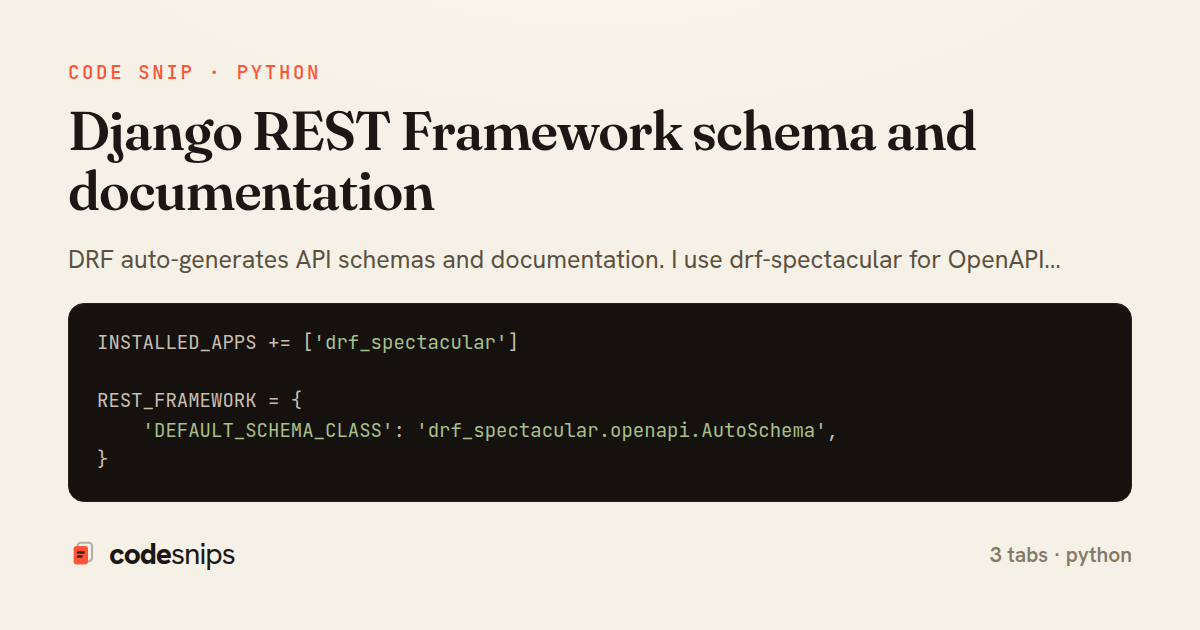
INSTALLED_APPS += ['drf_spectacular']

REST_FRAMEWORK = {
    'DEFAULT_SCHEMA_CLASS': 'drf_spectacular.openapi.AutoSchema',
}

SPECTACULAR_SETTINGS = {
    'TITLE': 'My API',
    'DESCRIPTION': 'API for my awesome project',
    'VERSION': '1.0.0',
    'SERVE_INCLUDE_SCHEMA': False,
}
from drf_spectacular.views import SpectacularAPIView, SpectacularSwaggerView
from django.urls import path

urlpatterns = [
    path('api/schema/', SpectacularAPIView.as_view(), name='schema'),
    path('api/docs/', SpectacularSwaggerView.as_view(url_name='schema'), name='swagger-ui'),
]
from drf_spectacular.utils import extend_schema, OpenApiParameter
from rest_framework import viewsets


class PostViewSet(viewsets.ModelViewSet):
    @extend_schema(
        summary='List all posts',
        description='Returns a paginated list of published posts',
        parameters=[
            OpenApiParameter(
                name='category',
                description='Filter by category slug',
                required=False,
                type=str
            ),
        ]
    )
    def list(self, request):
        """List posts with optional category filter."""
        return super().list(request)
3 files · python
Explain with highlit
DRF auto-generates API schemas and documentation. I use drf-spectacular for OpenAPI 3.0 schemas. The schema describes endpoints, parameters, and responses. I customize with decorators like @extend_schema. Interactive docs via Swagger UI or ReDoc let developers explore the API. I document parameters with type hints and docstrings. Schema generation works with serializers and viewsets automatically. For public APIs, good documentation is essential. I version schemas alongside API versions.
Related snips
python
import os
import stat

for root, _dirs, files in os.walk('/etc'):
    for name in files:
        path = os.path.join(root, name)
Python security audit script for exposed risky filesystem state
python
auditing
host-security
by Kai Nakamura
1 tab
python
class Product(models.Model):
    name = models.CharField(max_length=200)
    slug = models.SlugField(blank=True)
    price = models.DecimalField(max_digits=10, decimal_places=2)
    cost = models.DecimalField(max_digits=10, decimal_places=2)
    margin = models.DecimalField(max_digits=5, decimal_places=2, blank=True)
Django model signals vs overriding save
django
python
models
by Priya Sharma
2 tabs
python
from django.urls import path
from . import views

app_name = 'blog'

urlpatterns = [
Django URL namespacing and reverse lookups
django
python
urls
by Priya Sharma
3 tabs
python
import graphene
from graphene_django import DjangoObjectType
from blog.models import Post, Comment


class PostType(DjangoObjectType):
Django GraphQL with Graphene
django
python
graphql
by Priya Sharma
2 tabs
python
from django.db.models import Count, Avg, Sum, Q, F
from django.views.generic import TemplateView
from products.models import Product, Order, OrderItem


class DashboardView(TemplateView):
Django aggregation with annotate for statistics
django
python
database
by Priya Sharma
1 tab
python
from rest_framework import permissions


class IsOwner(permissions.BasePermission):
    """Allow only object owner to access."""
Django REST Framework permissions and authorization
django
python
rest
by Priya Sharma
2 tabs
Share this code
Here's the card — post it anywhere.