production:
  primary:
    adapter: postgresql
    url: <%= ENV['DATABASE_URL'] %>
    pool: <%= ENV.fetch("RAILS_MAX_THREADS", 5) %>
  primary_replica:
    adapter: postgresql
    url: <%= ENV['DATABASE_REPLICA_URL'] %>
    pool: <%= ENV.fetch("RAILS_MAX_THREADS", 5) %>
    replica: true
class ApplicationRecord < ActiveRecord::Base
  primary_abstract_class

  connects_to database: { writing: :primary, reading: :primary_replica }
end
module Api
  module V1
    class PostsController < BaseController
      around_action :use_read_replica, only: [:index, :show]

      def index
        posts = Post.published.includes(:author).page(params[:page])
        render json: posts
      end

      def create
        # Automatically uses primary for writes
        post = current_user.posts.create!(post_params)
        render json: post, status: :created
      end

      private

      def use_read_replica
        ActiveRecord::Base.connected_to(role: :reading) do
          yield
        end
      end
    end
  end
end
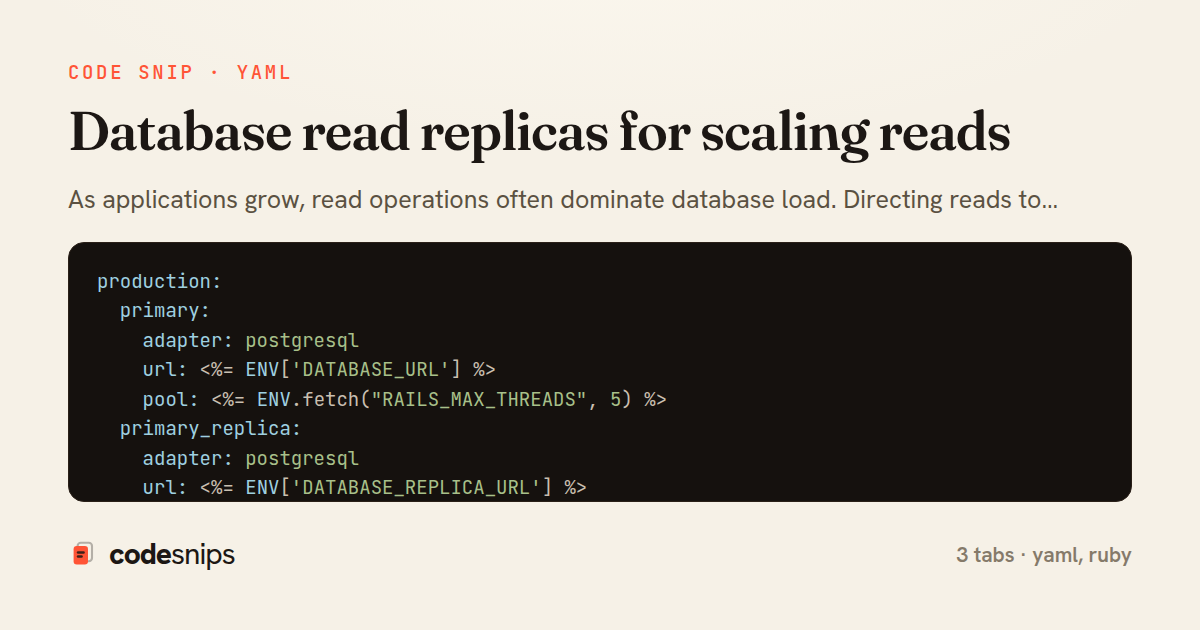
As applications grow, read operations often dominate database load. Directing reads to replica databases while keeping writes on the primary reduces contention and improves response times. Rails makes this straightforward with connects_to and role-based routing. I configure database.yml with separate connection pools for primary and replica, and use ActiveRecord::Base.connected_to(role: :reading) blocks to route queries to replicas. The framework automatically routes writes to primary regardless of the current role. For API endpoints that only read data, I set a controller-level around_action to use the reading role by default. Replica lag is a consideration—I use primaries for reads immediately after writes to avoid stale data.
Related snips
-- Simple function
CREATE OR REPLACE FUNCTION get_full_name(
  first_name VARCHAR,
  last_name VARCHAR
)
RETURNS VARCHAR AS $$
Stored procedures and functions in PostgreSQL
class CommentsController < ApplicationController
  before_action :set_post

  def create
    @comment = @post.comments.build(comment_params)
System test: asserting Turbo Stream responses
class Post < ApplicationRecord
  belongs_to :author, class_name: 'User'
  has_many :comments, dependent: :destroy

  scope :published, -> { where.not(published_at: nil).where('published_at <= ?', Time.current) }
  scope :draft, -> { where(published_at: nil) }
ActiveRecord scopes for reusable query logic
module Api
  module V1
    class UsersController < BaseController
      def show
        user = User.includes(:profile).find(params[:id])
ETags for conditional requests and caching
class PostsController < ApplicationController
  def index
    @posts = Post.includes(:author)
                 .order(created_at: :desc)
                 .page(params[:page])
                 .per(10)
Turbo Frames: infinite scroll with lazy-loading frame
require "csv"

class PeopleCsvStream
  include Enumerable

  HEADERS = %w[id full_name email signed_up_at plan].freeze
Resilient CSV Export as a Streamed Response
Share this code
Here's the card — post it anywhere.