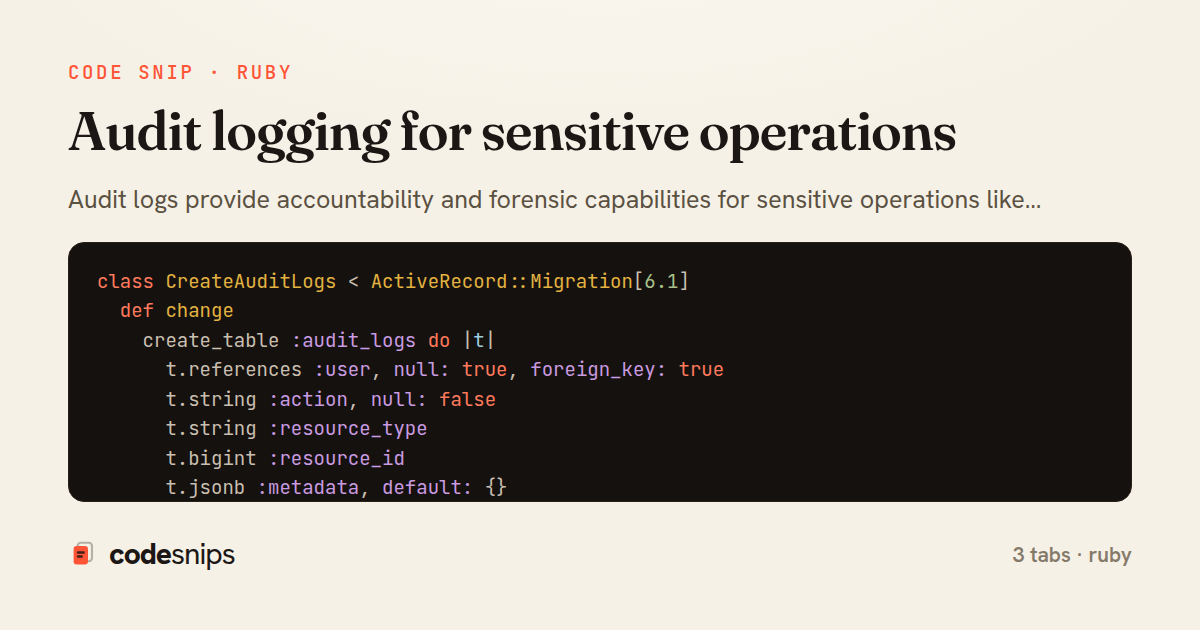
class CreateAuditLogs < ActiveRecord::Migration[6.1]
  def change
    create_table :audit_logs do |t|
      t.references :user, null: true, foreign_key: true
      t.string :action, null: false
      t.string :resource_type
      t.bigint :resource_id
      t.jsonb :metadata, default: {}
      t.jsonb :changes, default: {}
      t.inet :ip_address
      t.string :user_agent
      t.timestamp :created_at, null: false
    end

    add_index :audit_logs, [:resource_type, :resource_id]
    add_index :audit_logs, :action
    add_index :audit_logs, :created_at
    add_index :audit_logs, :metadata, using: :gin
  end
end
class AuditLog < ApplicationRecord
  belongs_to :user, optional: true

  validates :action, presence: true

  def self.log(action:, user: nil, resource: nil, changes: {}, metadata: {}, request: nil)
    create!(
      user: user,
      action: action,
      resource_type: resource&.class&.name,
      resource_id: resource&.id,
      changes: changes,
      metadata: metadata,
      ip_address: request&.remote_ip,
      user_agent: request&.user_agent
    )
  end
end
class UpdateUserRoleService
  def initialize(user:, new_role:, performed_by:, request:)
    @user = user
    @new_role = new_role
    @performed_by = performed_by
    @request = request
  end

  def call
    old_role = @user.role

    @user.update!(role: @new_role)

    AuditLog.log(
      action: 'user.role_changed',
      user: @performed_by,
      resource: @user,
      changes: { role: [old_role, @new_role] },
      metadata: { reason: 'admin_action' },
      request: @request
    )

    Result.success(user: @user)
  rescue StandardError => e
    Result.failure(error: e.message)
  end
end
Audit logs provide accountability and forensic capabilities for sensitive operations like permission changes, data deletion, or financial transactions. I store audit events in a dedicated table with who performed the action, what changed, when it occurred, and the request context (IP, user agent). For data changes, I use paper_trail gem to track all versions of critical models automatically. Each audit entry includes a JSON payload with before/after states so I can reconstruct history or implement undo functionality. Audit logs are write-only and never deleted—I archive old entries to cold storage but retain them indefinitely for compliance. For GDPR, I pseudonymize user identifiers while maintaining the ability to reconstruct events.
Related snips
class CommentsController < ApplicationController
  before_action :set_post

  def create
    @comment = @post.comments.build(comment_params)
System test: asserting Turbo Stream responses
class Post < ApplicationRecord
  belongs_to :author, class_name: 'User'
  has_many :comments, dependent: :destroy

  scope :published, -> { where.not(published_at: nil).where('published_at <= ?', Time.current) }
  scope :draft, -> { where(published_at: nil) }
ActiveRecord scopes for reusable query logic
payload = {
  sub: user.id,
  iss: 'https://auth.example.com',
  aud: 'codesnips-api',
  exp: 15.minutes.from_now.to_i,
  iat: Time.now.to_i,
JWT issuance and verification without common footguns
module Api
  module V1
    class UsersController < BaseController
      def show
        user = User.includes(:profile).find(params[:id])
ETags for conditional requests and caching
class PostsController < ApplicationController
  def index
    @posts = Post.includes(:author)
                 .order(created_at: :desc)
                 .page(params[:page])
                 .per(10)
Turbo Frames: infinite scroll with lazy-loading frame
require "csv"

class PeopleCsvStream
  include Enumerable

  HEADERS = %w[id full_name email signed_up_at plan].freeze
Resilient CSV Export as a Streamed Response
Share this code
Here's the card — post it anywhere.