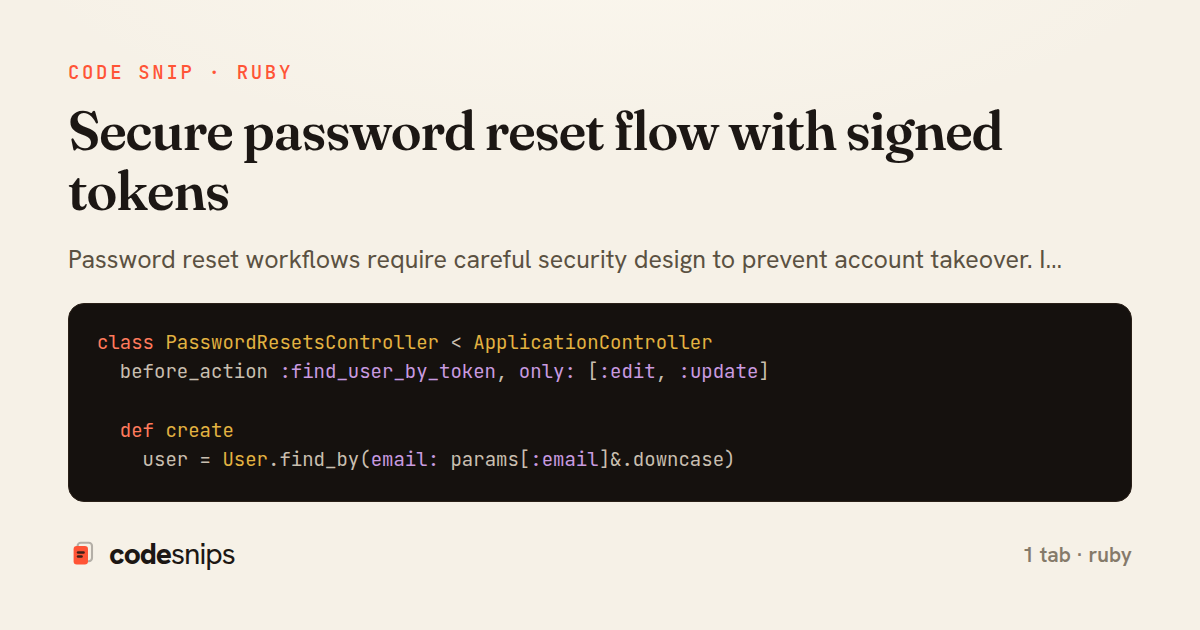
class PasswordResetsController < ApplicationController
  before_action :find_user_by_token, only: [:edit, :update]

  def create
    user = User.find_by(email: params[:email]&.downcase)

    if user
      token = user.signed_id(purpose: :password_reset, expires_in: 1.hour)
      UserMailer.password_reset(user, token).deliver_later
    end

    # Always show success to prevent email enumeration
    render json: { message: 'If that email exists, a reset link has been sent' }, status: :ok
  end

  def update
    if @user.update(password: params[:password], password_confirmation: params[:password_confirmation])
      # Invalidate all sessions
      @user.update_column(:auth_token, SecureRandom.hex(32))

      render json: { message: 'Password reset successfully' }, status: :ok
    else
      render json: { errors: @user.errors }, status: :unprocessable_entity
    end
  end

  private

  def find_user_by_token
    @user = User.find_signed(params[:token], purpose: :password_reset)

    unless @user
      render json: { error: 'INVALID_OR_EXPIRED_TOKEN' }, status: :unauthorized
    end
  end
end
Password reset workflows require careful security design to prevent account takeover. I generate time-limited, single-use tokens using Rails' signed_id feature which creates tamper-proof tokens without database storage. The token expires after a short window (1-2 hours) and includes the user's password_digest in the signature, so it automatically invalidates when the password changes. I send reset links via email to the address on file, never to user-provided addresses. The reset form requires the new password twice and doesn't echo the current password. Rate limiting prevents brute force token guessing. After successful reset, I invalidate all active sessions to protect against session fixation. This flow balances security and user experience.
Related snips
class CommentsController < ApplicationController
  before_action :set_post

  def create
    @comment = @post.comments.build(comment_params)
System test: asserting Turbo Stream responses
class Post < ApplicationRecord
  belongs_to :author, class_name: 'User'
  has_many :comments, dependent: :destroy

  scope :published, -> { where.not(published_at: nil).where('published_at <= ?', Time.current) }
  scope :draft, -> { where(published_at: nil) }
ActiveRecord scopes for reusable query logic
payload = {
  sub: user.id,
  iss: 'https://auth.example.com',
  aud: 'codesnips-api',
  exp: 15.minutes.from_now.to_i,
  iat: Time.now.to_i,
JWT issuance and verification without common footguns
module Api
  module V1
    class UsersController < BaseController
      def show
        user = User.includes(:profile).find(params[:id])
ETags for conditional requests and caching
class PostsController < ApplicationController
  def index
    @posts = Post.includes(:author)
                 .order(created_at: :desc)
                 .page(params[:page])
                 .per(10)
Turbo Frames: infinite scroll with lazy-loading frame
require "csv"

class PeopleCsvStream
  include Enumerable

  HEADERS = %w[id full_name email signed_up_at plan].freeze
Resilient CSV Export as a Streamed Response
Share this code
Here's the card — post it anywhere.