Jordan Lee
Jan 2026
3 tabs
<article class="post">
  <h1><%= @post.title %></h1>
  <%= simple_format @post.body %>

  <!-- Lazy load comments when scrolled into view -->
  <%= turbo_frame_tag "post_#{@post.id}_comments",
      src: post_comments_path(@post),
      loading: :lazy do %>
    <div class="text-center py-8">
      <div class="spinner"></div>
      <p class="text-gray-500">Loading comments...</p>
    </div>
  <% end %>

  <!-- Lazy load related posts -->
  <%= turbo_frame_tag "related_posts",
      src: related_posts_path(@post),
      loading: :lazy do %>
    <div class="h-64 bg-gray-100 animate-pulse"></div>
  <% end %>
</article>
class CommentsController < ApplicationController
  def index
    @post = Post.find(params[:post_id])
    @comments = @post.comments.includes(:author).order(created_at: :desc)

    # Return just the frame content, no layout
    render layout: false
  end
end
<%= turbo_frame_tag "post_#{@post.id}_comments" do %>
  <div class="comments">
    <h2 class="text-xl font-bold mb-4"><%= @comments.count %> Comments</h2>

    <div class="space-y-4">
      <%= render @comments %>
    </div>
  </div>
<% end %>
3 files · erb, ruby
Explain with highlit
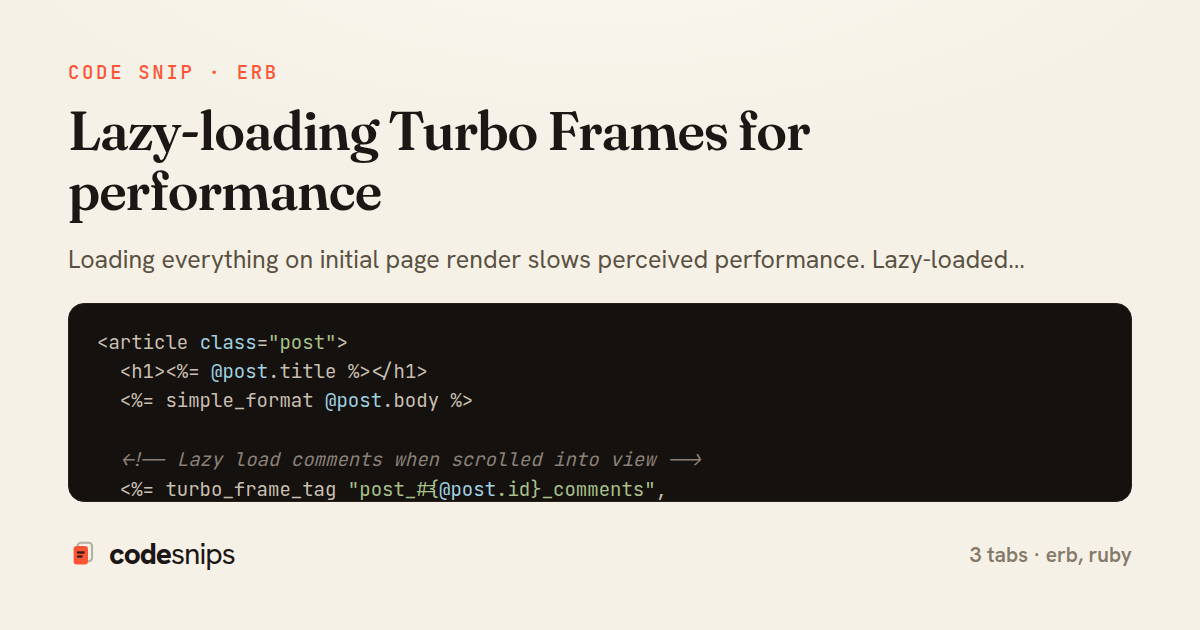
Loading everything on initial page render slows perceived performance. Lazy-loaded Turbo Frames defer expensive content until it's needed, keeping initial page loads fast. Setting loading='lazy' with a src attribute tells Turbo to fetch content when the frame enters the viewport. I use this for comment sections, user activity feeds, or related content that's below the fold. The server endpoint returns just the frame content, not the full page layout. Users on slow connections get the critical content first, then secondary content streams in as they scroll. The pattern also works for click-to-reveal scenarios where loading='lazy' is omitted but src is still provided.
Related snips
ruby
class CommentsController < ApplicationController
  before_action :set_post

  def create
    @comment = @post.comments.build(comment_params)
System test: asserting Turbo Stream responses
rails
hotwire
turbo
by codesnips
4 tabs
ruby
class Post < ApplicationRecord
  belongs_to :author, class_name: 'User'
  has_many :comments, dependent: :destroy

  scope :published, -> { where.not(published_at: nil).where('published_at <= ?', Time.current) }
  scope :draft, -> { where(published_at: nil) }
ActiveRecord scopes for reusable query logic
rails
activerecord
patterns
by Alex Kumar
1 tab
ruby
module Api
  module V1
    class UsersController < BaseController
      def show
        user = User.includes(:profile).find(params[:id])
ETags for conditional requests and caching
rails
caching
http-caching
by Alex Kumar
1 tab
ruby
class PostsController < ApplicationController
  def index
    @posts = Post.includes(:author)
                 .order(created_at: :desc)
                 .page(params[:page])
                 .per(10)
Turbo Frames: infinite scroll with lazy-loading frame
rails
turbo
hotwire
by codesnips
4 tabs
ruby
require "csv"

class PeopleCsvStream
  include Enumerable

  HEADERS = %w[id full_name email signed_up_at plan].freeze
Resilient CSV Export as a Streamed Response
rails
performance
streaming
by codesnips
3 tabs
erb
<form data-controller="query-sync" data-action="change->query-sync#apply">
  <select name="status" class="rounded border p-2">
    <option value="">Any</option>
    <option value="open">Open</option>
    <option value="closed">Closed</option>
  </select>
Filter UI that syncs query params via Stimulus (no front-end router)
rails
hotwire
stimulus
by Henry Kim
2 tabs
Share this code
Here's the card — post it anywhere.