Carlos Mendez
Jan 2026
4 tabs
{
  "private": true,
  "scripts": {
    "dev": "vite",
    "build": "vite build"
  },
  "devDependencies": {
    "@inertiajs/vue3": "^1.0.0",
    "@vitejs/plugin-vue": "^4.0.0",
    "autoprefixer": "^10.4.12",
    "laravel-vite-plugin": "^0.7.2",
    "postcss": "^8.4.18",
    "tailwindcss": "^3.2.1",
    "vite": "^4.0.0",
    "vue": "^3.2.41"
  }
}
<!DOCTYPE html>
<html>
<head>
    <meta charset="utf-8">
    <meta name="viewport" content="width=device-width, initial-scale=1">
    <title inertia>{{ config('app.name') }}</title>

    {{-- Include compiled assets --}}
    @vite(['resources/css/app.css', 'resources/js/app.js'])

    @inertiaHead
</head>
<body>
    @inertia
</body>
</html>
import { defineConfig } from 'vite';
import laravel from 'laravel-vite-plugin';
import vue from '@vitejs/plugin-vue';

export default defineConfig({
    plugins: [
        laravel({
            input: [
                'resources/css/app.css',
                'resources/js/app.js',
            ],
            refresh: true,
        }),
        vue({
            template: {
                transformAssetUrls: {
                    base: null,
                    includeAbsolute: false,
                },
            },
        }),
    ],
    resolve: {
        alias: {
            '@': '/resources/js',
        },
    },
});
import './bootstrap';
import '../css/app.css';

import { createApp, h } from 'vue';
import { createInertiaApp } from '@inertiajs/vue3';
import { resolvePageComponent } from 'laravel-vite-plugin/inertia-helpers';

createInertiaApp({
    title: (title) => `${title} - My App`,
    resolve: (name) => resolvePageComponent(
        `./Pages/${name}.vue`,
        import.meta.glob('./Pages/**/*.vue')
    ),
    setup({ el, App, props, plugin }) {
        return createApp({ render: () => h(App, props) })
            .use(plugin)
            .mount(el);
    },
    progress: {
        color: '#4B5563',
    },
});
4 files · json, blade, javascript
Explain with highlit
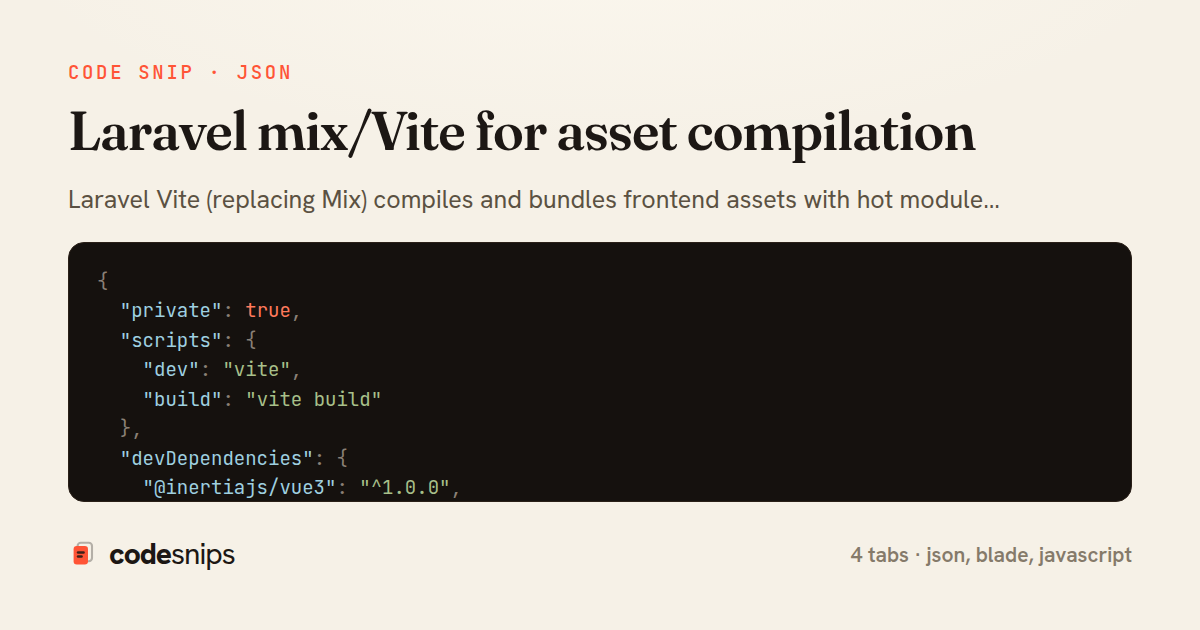
Laravel Vite (replacing Mix) compiles and bundles frontend assets with hot module replacement during development. I define entry points in vite.config.js—typically resources/js/app.js and resources/css/app.css. The @vite directive includes compiled assets in Blade. Running npm run dev starts the dev server with HMR. For production, npm run build creates optimized bundles with versioning. Vite supports Vue, React, TypeScript, PostCSS, and Tailwind out of the box. I use import statements for CSS and images—Vite handles bundling. Environment variables prefixed with VITE_ are accessible in frontend code. This modern tooling provides instant feedback during development and optimal builds for production.
Related snips
javascript
import { Controller } from "@hotwired/stimulus"

export default class extends Controller {
  static targets = ["form"]
  static values = { delay: { type: Number, default: 250 } }
Debounced live search with Stimulus + Turbo Streams
rails
hotwire
stimulus
by codesnips
4 tabs
php
<?php

namespace App\Providers;

use App\Contracts\PaymentGateway;
use App\Services\StripePaymentGateway;
Laravel service container and dependency injection
laravel
dependency-injection
service-container
by Carlos Mendez
2 tabs
javascript
import { Application } from "@hotwired/stimulus"
import FormSubmitController from "./controllers/form_submit_controller"

const application = Application.start()
application.debug = false
Disable submit button while Turbo form is submitting
rails
hotwire
stimulus
by codesnips
3 tabs
javascript
import { Controller } from "@hotwired/stimulus"

export default class extends Controller {
  static values = {
    url: String,
    delay: { type: Number, default: 800 },
Stimulus: autosave draft with Turbo-friendly requests
rails
stimulus
hotwire
by codesnips
3 tabs
typescript
import React from "react";

type FallbackProps = {
  error: Error;
  reset: () => void;
};
React Error Boundary + error reporting hook
react
frontend
error-boundary
by codesnips
3 tabs
erb
<nav class="site-nav" data-controller="preload">
  <ul>
    <li>
      <%= link_to "Dashboard", dashboard_path,
            class: "nav-link",
            data: { turbo_preload: true } %>
Speed up perceived performance with Turbo preload links
rails
hotwire
turbo
by codesnips
3 tabs
Share this code
Here's the card — post it anywhere.