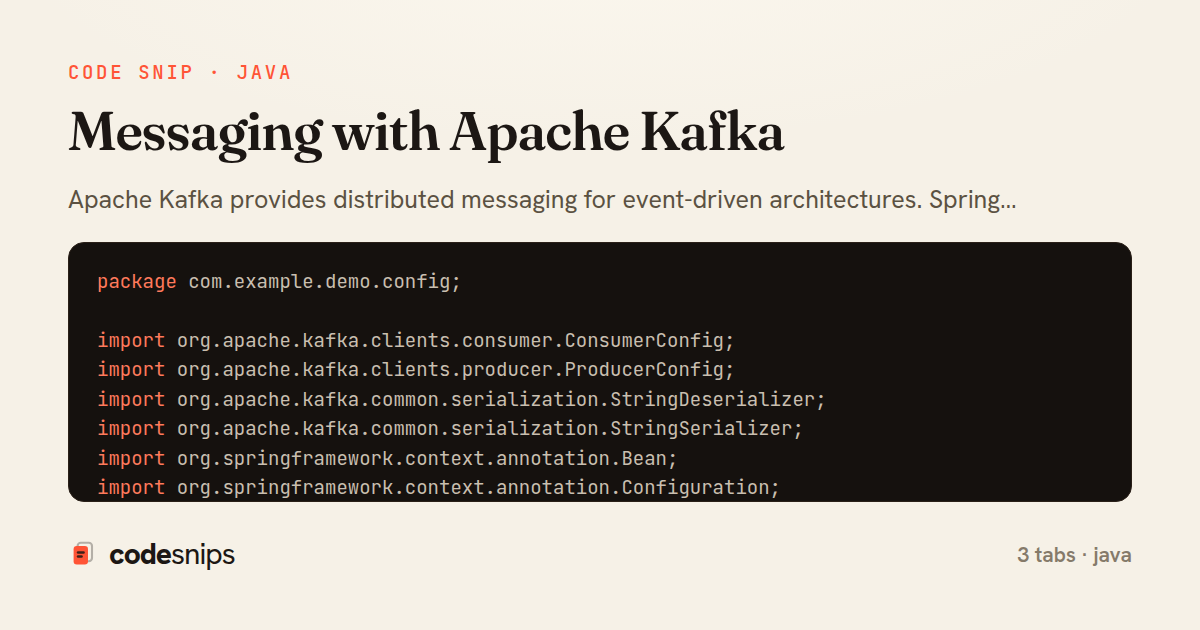
package com.example.demo.config;

import org.apache.kafka.clients.consumer.ConsumerConfig;
import org.apache.kafka.clients.producer.ProducerConfig;
import org.apache.kafka.common.serialization.StringDeserializer;
import org.apache.kafka.common.serialization.StringSerializer;
import org.springframework.context.annotation.Bean;
import org.springframework.context.annotation.Configuration;
import org.springframework.kafka.config.ConcurrentKafkaListenerContainerFactory;
import org.springframework.kafka.core.*;
import org.springframework.kafka.support.serializer.JsonDeserializer;
import org.springframework.kafka.support.serializer.JsonSerializer;

import java.util.HashMap;
import java.util.Map;

@Configuration
public class KafkaConfig {

    @Bean
    public ProducerFactory<String, Object> producerFactory() {
        Map<String, Object> config = new HashMap<>();
        config.put(ProducerConfig.BOOTSTRAP_SERVERS_CONFIG, "localhost:9092");
        config.put(ProducerConfig.KEY_SERIALIZER_CLASS_CONFIG, StringSerializer.class);
        config.put(ProducerConfig.VALUE_SERIALIZER_CLASS_CONFIG, JsonSerializer.class);
        config.put(ProducerConfig.ACKS_CONFIG, "all");
        config.put(ProducerConfig.RETRIES_CONFIG, 3);
        return new DefaultKafkaProducerFactory<>(config);
    }

    @Bean
    public KafkaTemplate<String, Object> kafkaTemplate() {
        return new KafkaTemplate<>(producerFactory());
    }

    @Bean
    public ConsumerFactory<String, Object> consumerFactory() {
        Map<String, Object> config = new HashMap<>();
        config.put(ConsumerConfig.BOOTSTRAP_SERVERS_CONFIG, "localhost:9092");
        config.put(ConsumerConfig.GROUP_ID_CONFIG, "user-service-group");
        config.put(ConsumerConfig.KEY_DESERIALIZER_CLASS_CONFIG, StringDeserializer.class);
        config.put(ConsumerConfig.VALUE_DESERIALIZER_CLASS_CONFIG, JsonDeserializer.class);
        config.put(JsonDeserializer.TRUSTED_PACKAGES, "com.example.demo.*");
        config.put(ConsumerConfig.AUTO_OFFSET_RESET_CONFIG, "earliest");
        return new DefaultKafkaConsumerFactory<>(config);
    }

    @Bean
    public ConcurrentKafkaListenerContainerFactory<String, Object> kafkaListenerContainerFactory() {
        ConcurrentKafkaListenerContainerFactory<String, Object> factory =
            new ConcurrentKafkaListenerContainerFactory<>();
        factory.setConsumerFactory(consumerFactory());
        factory.setConcurrency(3);
        return factory;
    }
}
package com.example.demo.service;

import com.example.demo.dto.UserEvent;
import org.slf4j.Logger;
import org.slf4j.LoggerFactory;
import org.springframework.kafka.core.KafkaTemplate;
import org.springframework.kafka.support.SendResult;
import org.springframework.stereotype.Service;

import java.util.concurrent.CompletableFuture;

@Service
public class KafkaProducerService {

    private static final Logger logger = LoggerFactory.getLogger(KafkaProducerService.class);
    private static final String USER_EVENTS_TOPIC = "user-events";

    private final KafkaTemplate<String, Object> kafkaTemplate;

    public KafkaProducerService(KafkaTemplate<String, Object> kafkaTemplate) {
        this.kafkaTemplate = kafkaTemplate;
    }

    public void sendUserEvent(UserEvent event) {
        CompletableFuture<SendResult<String, Object>> future =
            kafkaTemplate.send(USER_EVENTS_TOPIC, event.getUserId().toString(), event);

        future.whenComplete((result, ex) -> {
            if (ex == null) {
                logger.info("Sent message=[{}] with offset=[{}]",
                    event, result.getRecordMetadata().offset());
            } else {
                logger.error("Unable to send message=[{}] due to: {}", event, ex.getMessage());
            }
        });
    }

    public void sendUserCreated(Long userId, String email) {
        UserEvent event = new UserEvent("USER_CREATED", userId, email);
        sendUserEvent(event);
    }

    public void sendUserUpdated(Long userId, String email) {
        UserEvent event = new UserEvent("USER_UPDATED", userId, email);
        sendUserEvent(event);
    }
}
package com.example.demo.service;

import com.example.demo.dto.UserEvent;
import org.slf4j.Logger;
import org.slf4j.LoggerFactory;
import org.springframework.kafka.annotation.KafkaListener;
import org.springframework.kafka.support.KafkaHeaders;
import org.springframework.messaging.handler.annotation.Header;
import org.springframework.messaging.handler.annotation.Payload;
import org.springframework.stereotype.Service;

@Service
public class KafkaConsumerService {

    private static final Logger logger = LoggerFactory.getLogger(KafkaConsumerService.class);

    @KafkaListener(topics = "user-events", groupId = "user-service-group")
    public void consumeUserEvent(@Payload UserEvent event,
                                 @Header(KafkaHeaders.RECEIVED_PARTITION) int partition,
                                 @Header(KafkaHeaders.OFFSET) long offset) {
        logger.info("Received user event: {} from partition: {} with offset: {}",
            event, partition, offset);

        switch (event.getEventType()) {
            case "USER_CREATED":
                handleUserCreated(event);
                break;
            case "USER_UPDATED":
                handleUserUpdated(event);
                break;
            default:
                logger.warn("Unknown event type: {}", event.getEventType());
        }
    }

    private void handleUserCreated(UserEvent event) {
        logger.info("Processing user created: {}", event.getUserId());
        // Send welcome email, create user profile, etc.
    }

    private void handleUserUpdated(UserEvent event) {
        logger.info("Processing user updated: {}", event.getUserId());
        // Invalidate cache, notify other services, etc.
    }
}
Apache Kafka provides distributed messaging for event-driven architectures. Spring Kafka simplifies producer and consumer implementations. KafkaTemplate sends messages to topics. @KafkaListener consumes messages asynchronously. I configure serializers/deserializers for message formats—JSON, Avro, Protobuf. Partitioning distributes load across consumers. Consumer groups enable parallel processing. Acknowledgment modes control reliability—manual ack for critical messages, automatic for throughput. Error handling uses retry topics and dead letter queues. Kafka enables microservices communication, event sourcing, and real-time data pipelines. Transaction support ensures exactly-once semantics. Headers carry metadata. The pub-sub model decouples services, improving scalability and resilience. Proper topic design and partition strategies are crucial for performance.
Related snips
type User {
    id: ID!
    name: String!
    email: String!
    posts: [Post!]!
    createdAt: String!
GraphQL API with Spring Boot
package com.example.starter.config;

import com.example.starter.properties.CustomProperties;
import com.example.starter.service.CustomService;
import org.springframework.boot.autoconfigure.AutoConfiguration;
import org.springframework.boot.autoconfigure.condition.ConditionalOnClass;
Custom Spring Boot starters
-- Publisher: Send notification
NOTIFY new_order, 'Order #12345 created';

-- Subscriber: Listen for notifications
LISTEN new_order;
PostgreSQL LISTEN/NOTIFY for pub-sub messaging
CREATE TABLE outbox (
    id             BIGSERIAL PRIMARY KEY,
    aggregate_type TEXT        NOT NULL,
    aggregate_id   TEXT        NOT NULL,
    event_type     TEXT        NOT NULL,
    payload        JSONB       NOT NULL,
Transactional outbox in Node (DB write + event)
package com.example.demo.controller;

import com.example.demo.dto.FileMetadata;
import com.example.demo.service.FileStorageService;
import org.springframework.core.io.Resource;
import org.springframework.http.HttpHeaders;
File upload and download handling
CREATE TABLE users (
    id BIGSERIAL PRIMARY KEY,
    username VARCHAR(100) NOT NULL UNIQUE,
    email VARCHAR(255) NOT NULL UNIQUE,
    password VARCHAR(255) NOT NULL,
    created_at TIMESTAMP NOT NULL DEFAULT CURRENT_TIMESTAMP,
Database migration with Flyway
Share this code
Here's the card — post it anywhere.