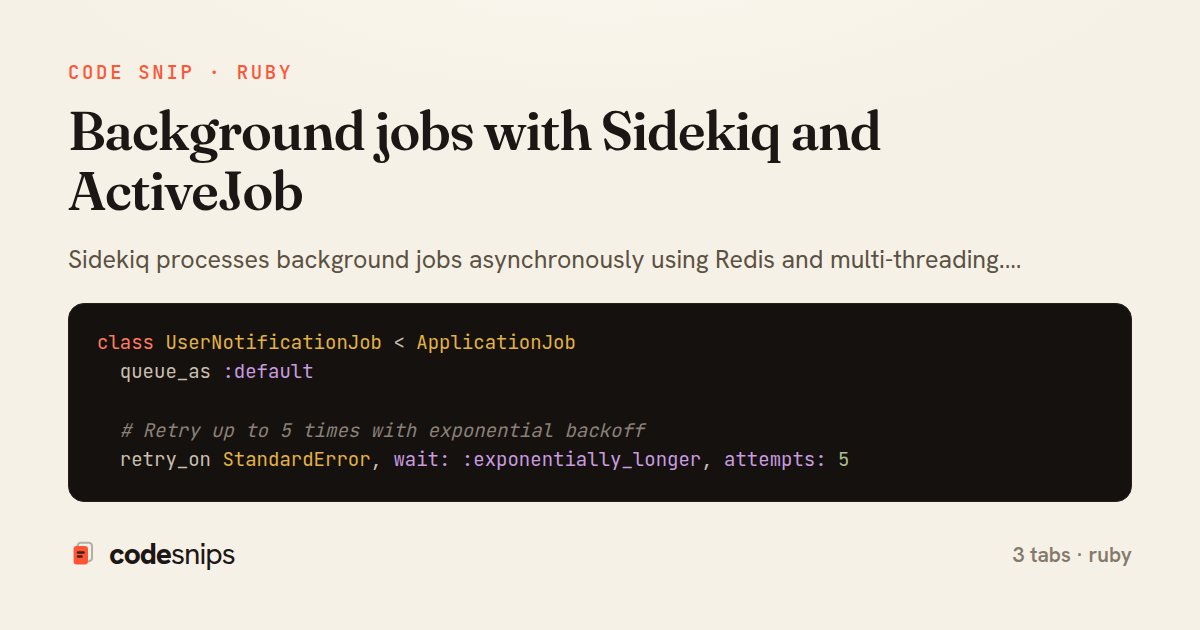
class UserNotificationJob < ApplicationJob
  queue_as :default

  # Retry up to 5 times with exponential backoff
  retry_on StandardError, wait: :exponentially_longer, attempts: 5

  # Discard job if user not found
  discard_on ActiveRecord::RecordNotFound

  def perform(user_id, notification_type, data = {})
    user = User.find(user_id)

    case notification_type
    when 'email'
      send_email_notification(user, data)
    when 'push'
      send_push_notification(user, data)
    when 'sms'
      send_sms_notification(user, data)
    end

    track_notification_sent(user, notification_type)
  end

  private

  def send_email_notification(user, data)
    UserMailer.notification(user, data).deliver_now
  end

  def send_push_notification(user, data)
    PushNotificationService.new(user).send(data[:message])
  end

  def send_sms_notification(user, data)
    TwilioService.send_sms(user.phone, data[:message])
  end

  def track_notification_sent(user, type)
    Analytics.track(
      user_id: user.id,
      event: 'notification_sent',
      properties: { type: type }
    )
  end
end

# Usage:
# Enqueue immediately
# UserNotificationJob.perform_later(user.id, 'email', { subject: 'Welcome!' })
#
# Enqueue with delay
# UserNotificationJob.set(wait: 1.hour).perform_later(user.id, 'email', data)
#
# Schedule for specific time
# UserNotificationJob.set(wait_until: Date.tomorrow.noon).perform_later(user.id, 'push', data)
class ReportGeneratorJob < ApplicationJob
  queue_as :reports

  # Custom retry logic
  retry_on ReportGenerationError, wait: 5.minutes, attempts: 3 do |job, error|
    # Notify admin on final failure
    AdminMailer.job_failed(job, error).deliver_now
  end

  def perform(report_id)
    report = Report.find(report_id)

    report.update!(status: 'processing')

    csv_data = generate_csv_data(report)
    file = upload_to_storage(csv_data, report)

    report.update!(
      status: 'completed',
      file_url: file.url,
      completed_at: Time.current
    )

    notify_user(report)
  rescue StandardError => e
    report.update!(
      status: 'failed',
      error_message: e.message
    )
    raise
  end

  private

  def generate_csv_data(report)
    CSV.generate do |csv|
      csv << ['ID', 'Name', 'Email', 'Created At']

      report.data_scope.find_each do |record|
        csv << [record.id, record.name, record.email, record.created_at]
      end
    end
  end

  def upload_to_storage(csv_data, report)
    filename = "report_#{report.id}_#{Time.current.to_i}.csv"

    file = StringIO.new(csv_data)
    report.file.attach(
      io: file,
      filename: filename,
      content_type: 'text/csv'
    )

    report.file
  end

  def notify_user(report)
    ReportMailer.ready(report).deliver_later
  end
end
class BatchProcessorJob < ApplicationJob
  queue_as :batch

  BATCH_SIZE = 100

  def perform(model_name, ids)
    model = model_name.constantize

    model.where(id: ids).find_in_batches(batch_size: BATCH_SIZE) do |batch|
      batch.each do |record|
        process_record(record)
      end
    end
  end

  private

  def process_record(record)
    # Process individual record
    record.process!
  rescue StandardError => e
    Rails.logger.error("Failed to process #{record.class.name} #{record.id}: #{e.message}")
  end
end

# Sidekiq-specific features
class HighPriorityJob
  include Sidekiq::Job

  sidekiq_options queue: :critical, retry: 10, backtrace: true

  def perform(user_id)
    # Critical operation
  end
end

# Scheduled job (requires sidekiq-scheduler gem)
class DailyCleanupJob
  include Sidekiq::Job

  sidekiq_options queue: :maintenance

  def perform
    User.inactive.where('last_login_at < ?', 1.year.ago).destroy_all
    Session.expired.delete_all
  end
end
Sidekiq processes background jobs asynchronously using Redis and multi-threading. ActiveJob provides framework-agnostic interface—I use it for portability between job processors. Jobs handle emails, data processing, API calls, report generation. perform_later enqueues jobs; perform_now executes synchronously. I set priorities and queues for job organization. Retry logic with exponential backoff handles transient failures. Dead job queues capture permanent failures. Unique jobs prevent duplicates using sidekiq-unique-jobs gem. Scheduled jobs use set(wait:) or cron schedules. Batch processing groups related jobs. Monitoring via Sidekiq Web UI tracks throughput and failures. Proper job design—idempotent, atomic operations—ensures reliability. Background processing improves response times and user experience.
Related snips
class CommentsController < ApplicationController
  before_action :set_post

  def create
    @comment = @post.comments.build(comment_params)
System test: asserting Turbo Stream responses
class Money
  include Comparable

  attr_reader :amount, :currency

  def initialize(amount, currency = 'USD')
Value objects for domain modeling
class Post < ApplicationRecord
  belongs_to :author, class_name: 'User'
  has_many :comments, dependent: :destroy

  scope :published, -> { where.not(published_at: nil).where('published_at <= ?', Time.current) }
  scope :draft, -> { where(published_at: nil) }
ActiveRecord scopes for reusable query logic
module Api
  module V1
    class UsersController < BaseController
      def show
        user = User.includes(:profile).find(params[:id])
ETags for conditional requests and caching
class PostsController < ApplicationController
  def index
    @posts = Post.includes(:author)
                 .order(created_at: :desc)
                 .page(params[:page])
                 .per(10)
Turbo Frames: infinite scroll with lazy-loading frame
require "csv"

class PeopleCsvStream
  include Enumerable

  HEADERS = %w[id full_name email signed_up_at plan].freeze
Resilient CSV Export as a Streamed Response
Share this code
Here's the card — post it anywhere.