ruby
136 lines · 3 tabs
Sarah Mitchell
Feb 2026
3 tabs
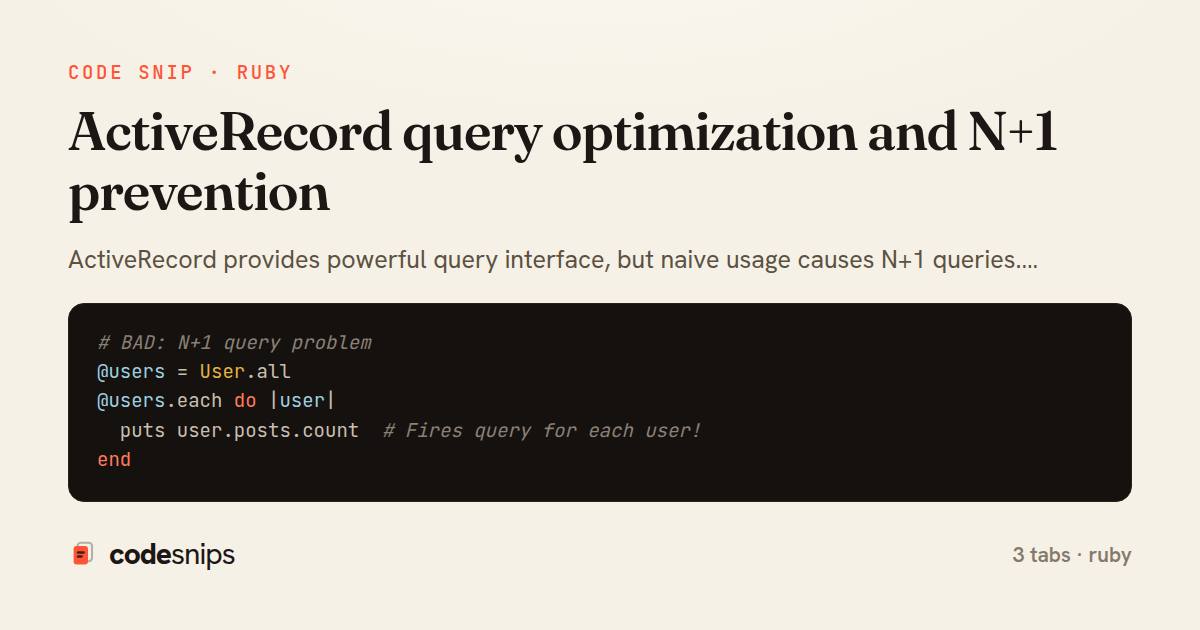
# BAD: N+1 query problem
@users = User.all
@users.each do |user|
  puts user.posts.count  # Fires query for each user!
end

# GOOD: Eager loading with includes
@users = User.includes(:posts).all
@users.each do |user|
  puts user.posts.count  # No additional queries
end

# Multiple associations
@users = User.includes(:posts, :comments, profile: :avatar)

# Conditional eager loading
@users = User.includes(:posts).where(posts: { published: true })

# Using joins for filtering (doesn't load association)
@users = User.joins(:posts).where(posts: { status: 'published' }).distinct

# Preload vs Eager Load
User.preload(:posts)     # Always 2 queries
User.eager_load(:posts)  # Always LEFT OUTER JOIN
User.includes(:posts)    # Smart choice based on conditions

# Select specific columns
User.select(:id, :name, :email)  # Only fetch needed columns

# Pluck for single/multiple columns (returns array, not AR objects)
User.pluck(:email)              # => ["alice@example.com", ...]
User.pluck(:id, :name)          # => [[1, "Alice"], [2, "Bob"]]

# exists? vs present?/any?
User.where(status: 'active').exists?  # Fast COUNT query
User.where(status: 'active').any?     # Loads records into memory
class Post < ApplicationRecord
  belongs_to :user
  has_many :comments

  # Scopes for reusable queries
  scope :published, -> { where(status: 'published') }
  scope :recent, -> { where('created_at > ?', 1.week.ago) }
  scope :popular, -> { where('views_count > ?', 1000) }
  scope :by_author, ->(user_id) { where(user_id: user_id) }

  # Combining scopes
  scope :trending, -> { published.recent.popular }

  # Counter cache
  belongs_to :user, counter_cache: true  # Adds posts_count to users

  # Custom SQL with sanitization
  def self.search(term)
    where('title ILIKE :term OR content ILIKE :term', term: "%#{sanitize_sql_like(term)}%")
  end

  # Subqueries
  def self.with_recent_comments
    where(id: Comment.select(:post_id).where('created_at > ?', 1.day.ago))
  end

  # Aggregations
  def self.statistics
    group(:status).count
    # => { "published" => 150, "draft" => 42 }
  end

  def self.avg_views_by_category
    joins(:category).group('categories.name').average(:views_count)
  end
end

# Batch processing for large datasets
User.find_each(batch_size: 1000) do |user|
  user.update_statistics
end

# find_in_batches returns arrays
User.find_in_batches(batch_size: 500) do |users|
  UserExportService.export(users)
end

# Merge scopes
class User < ApplicationRecord
  scope :active, -> { where(status: 'active') }
end

Post.joins(:user).merge(User.active)

# Upsert (Rails 6+)
User.upsert(
  { email: 'alice@example.com', name: 'Alice' },
  unique_by: :email
)

# Upsert multiple
User.upsert_all([
  { email: 'alice@example.com', name: 'Alice' },
  { email: 'bob@example.com', name: 'Bob' }
], unique_by: :email)
# Migration with indices
class CreatePosts < ActiveRecord::Migration[6.1]
  def change
    create_table :posts do |t|
      t.references :user, null: false, foreign_key: true, index: true
      t.string :title, null: false
      t.text :content
      t.string :status, null: false, default: 'draft'
      t.integer :views_count, default: 0
      t.timestamps
    end

    # Composite index for common queries
    add_index :posts, [:user_id, :status]
    add_index :posts, [:status, :created_at]

    # Partial index (PostgreSQL)
    add_index :posts, :created_at, where: "status = 'published'"

    # Full-text search index (PostgreSQL)
    execute "CREATE INDEX posts_content_search_idx ON posts USING gin(to_tsvector('english', content))"
  end
end

# Query analysis
Post.where(user_id: 1, status: 'published').explain
# Shows query plan and index usage

# Benchmark queries
require 'benchmark'

Benchmark.bm do |x|
  x.report("without index:") { Post.where(title: 'Test').load }
  x.report("with index:") { Post.where(title: 'Test').load }
end
3 files · ruby
Explain with highlit
ActiveRecord provides powerful query interface, but naive usage causes N+1 queries. includes eager loads associations in 2-3 queries. joins performs SQL JOINs for filtering. preload always uses separate queries; eager_load forces LEFT OUTER JOIN. I use select to limit columns, reducing memory. find_each and find_in_batches process large datasets efficiently. Scopes chain for composable queries. merge combines scopes. Counter caches avoid COUNT queries. Database indices speed lookups—I add indices on foreign keys and frequently queried columns. explain reveals query plans. Bullet gem detects N+1 in development. Proper query optimization dramatically improves performance, especially at scale.
Related snips
ruby
class CommentsController < ApplicationController
  before_action :set_post

  def create
    @comment = @post.comments.build(comment_params)
System test: asserting Turbo Stream responses
rails
hotwire
turbo
by codesnips
4 tabs
ruby
class Money
  include Comparable

  attr_reader :amount, :currency

  def initialize(amount, currency = 'USD')
Value objects for domain modeling
ruby
value-objects
domain-driven-design
by Sarah Mitchell
2 tabs
ruby
class Post < ApplicationRecord
  belongs_to :author, class_name: 'User'
  has_many :comments, dependent: :destroy

  scope :published, -> { where.not(published_at: nil).where('published_at <= ?', Time.current) }
  scope :draft, -> { where(published_at: nil) }
ActiveRecord scopes for reusable query logic
rails
activerecord
patterns
by Alex Kumar
1 tab
ruby
module Api
  module V1
    class UsersController < BaseController
      def show
        user = User.includes(:profile).find(params[:id])
ETags for conditional requests and caching
rails
caching
http-caching
by Alex Kumar
1 tab
ruby
class PostsController < ApplicationController
  def index
    @posts = Post.includes(:author)
                 .order(created_at: :desc)
                 .page(params[:page])
                 .per(10)
Turbo Frames: infinite scroll with lazy-loading frame
rails
turbo
hotwire
by codesnips
4 tabs
ruby
require "csv"

class PeopleCsvStream
  include Enumerable

  HEADERS = %w[id full_name email signed_up_at plan].freeze
Resilient CSV Export as a Streamed Response
rails
performance
streaming
by codesnips
3 tabs
Share this code
Here's the card — post it anywhere.