yaml
129 lines · 1 tab
Ryan Nakamura
Feb 2026
1 tab
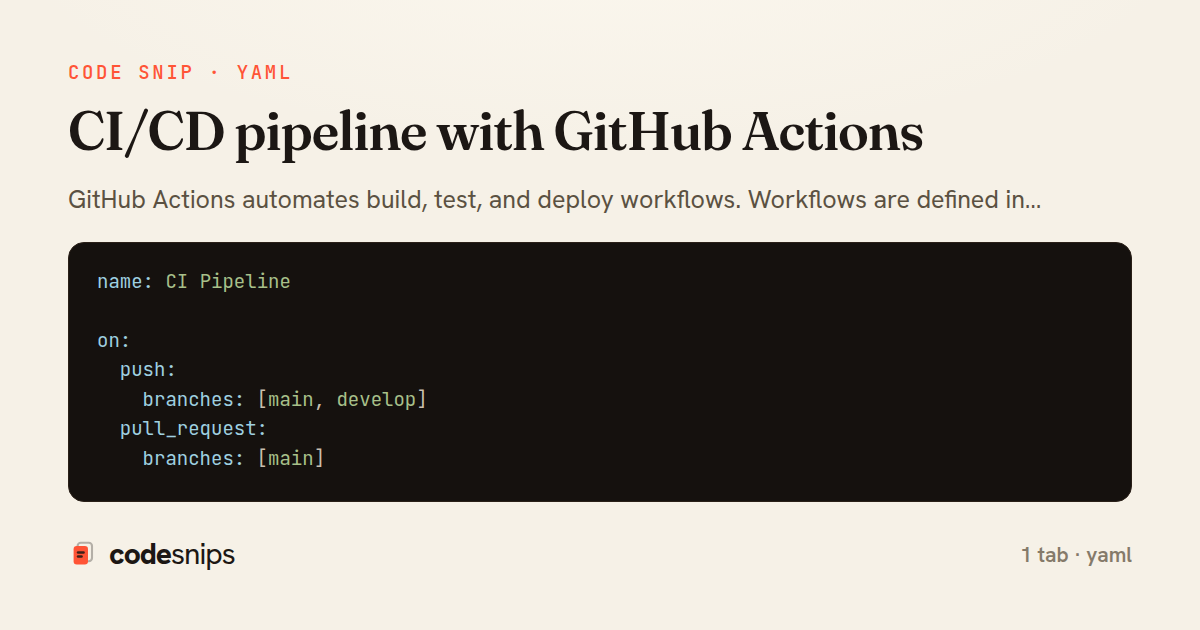
name: CI Pipeline

on:
  push:
    branches: [main, develop]
  pull_request:
    branches: [main]

concurrency:
  group: ci-${{ github.ref }}
  cancel-in-progress: true

env:
  NODE_VERSION: '20'
  REGISTRY: ghcr.io
  IMAGE_NAME: ${{ github.repository }}

jobs:
  lint:
    name: Lint & Format
    runs-on: ubuntu-latest
    steps:
      - uses: actions/checkout@v4

      - uses: actions/setup-node@v4
        with:
          node-version: ${{ env.NODE_VERSION }}
          cache: npm

      - run: npm ci
      - run: npm run lint
      - run: npm run format:check

  test:
    name: Test
    runs-on: ubuntu-latest
    needs: lint
    strategy:
      matrix:
        node-version: [18, 20, 22]
    services:
      postgres:
        image: postgres:16
        env:
          POSTGRES_DB: test
          POSTGRES_PASSWORD: test
        ports:
          - 5432:5432
        options: >-
          --health-cmd pg_isready
          --health-interval 10s
          --health-timeout 5s
          --health-retries 5
    steps:
      - uses: actions/checkout@v4

      - uses: actions/setup-node@v4
        with:
          node-version: ${{ matrix.node-version }}
          cache: npm

      - run: npm ci
      - run: npm test -- --coverage
        env:
          DATABASE_URL: postgres://postgres:test@localhost:5432/test

      - uses: actions/upload-artifact@v4
        if: matrix.node-version == 20
        with:
          name: coverage
          path: coverage/

  build:
    name: Build & Push Image
    runs-on: ubuntu-latest
    needs: test
    if: github.ref == 'refs/heads/main'
    permissions:
      contents: read
      packages: write
    outputs:
      image-tag: ${{ steps.meta.outputs.tags }}
    steps:
      - uses: actions/checkout@v4

      - uses: docker/setup-buildx-action@v3

      - uses: docker/login-action@v3
        with:
          registry: ${{ env.REGISTRY }}
          username: ${{ github.actor }}
          password: ${{ secrets.GITHUB_TOKEN }}

      - id: meta
        uses: docker/metadata-action@v5
        with:
          images: ${{ env.REGISTRY }}/${{ env.IMAGE_NAME }}
          tags: |
            type=sha
            type=semver,pattern={{version}}

      - uses: docker/build-push-action@v5
        with:
          context: .
          push: true
          tags: ${{ steps.meta.outputs.tags }}
          labels: ${{ steps.meta.outputs.labels }}
          cache-from: type=gha
          cache-to: type=gha,mode=max

  deploy:
    name: Deploy to Production
    runs-on: ubuntu-latest
    needs: build
    environment:
      name: production
      url: https://app.example.com
    steps:
      - uses: actions/checkout@v4

      - uses: azure/setup-kubectl@v3

      - uses: azure/k8s-set-context@v3
        with:
          kubeconfig: ${{ secrets.KUBE_CONFIG }}

      - run: |
          kubectl set image deployment/web-app             web-app=${{ needs.build.outputs.image-tag }}             -n production
          kubectl rollout status deployment/web-app -n production
1 file · yaml
Explain with highlit
GitHub Actions automates build, test, and deploy workflows. Workflows are defined in .github/workflows/ YAML files. The on key specifies triggers—push, pull_request, schedule, or workflow_dispatch. Jobs run on runners with configurable OS. steps execute sequentially within a job. The uses keyword references reusable actions. env and secrets inject configuration securely. Matrix strategies test across multiple versions simultaneously. Caching with actions/cache speeds up dependency installation. Artifacts persist build outputs between jobs. Concurrency groups prevent duplicate runs. Environment protection rules gate deployments. Status checks enforce quality before merging.
Related snips
python
from sklearn.pipeline import Pipeline
from sklearn.preprocessing import StandardScaler, MinMaxScaler, RobustScaler
from sklearn.linear_model import LogisticRegression

standard_pipeline = Pipeline([
    ('scaler', StandardScaler()),
Scaling and normalization choices for different model families
feature-scaling
normalization
machine-learning
by Dr. Elena Vasquez
1 tab
javascript
// Express app with health checks and graceful shutdown
const express = require('express');
const { createServer } = require('http');

const app = express();
const server = createServer(app);
Container health checks and graceful shutdown patterns
docker
kubernetes
health-checks
by Ryan Nakamura
1 tab
javascript
// k6 Load Test Configuration
// Run: k6 run load-test.js --env BASE_URL=https://api.example.com

import http from 'k6/http';
import { check, sleep, group } from 'k6';
import { Rate, Trend, Counter } from 'k6/metrics';
Load testing APIs with k6 for performance validation
k6
load-testing
performance
by Ryan Nakamura
1 tab
hcl
# Using the module

module "api_service" {
  source = "./modules/ecs_service"

  service_name       = "api"
Terraform modules for reusable infrastructure
terraform
modules
iac
by Ryan Nakamura
2 tabs
javascript
import js from '@eslint/js';
import tseslint from 'typescript-eslint';
import prettierConfig from 'eslint-config-prettier';

export default [
  js.configs.recommended,
ESLint config that avoids bikeshedding
tooling
typescript
eslint
by codesnips
3 tabs
bash
#!/usr/bin/env bash
set -euo pipefail

# ==========================================================
# Production Incident Response Runbook
# ==========================================================
Incident response runbook and diagnostic scripts
incident-response
sre
production
by Ryan Nakamura
1 tab
Share this code
Here's the card — post it anywhere.