python
18 lines · 1 tab
Dr. Elena Vasquez
Apr 2026
1 tab
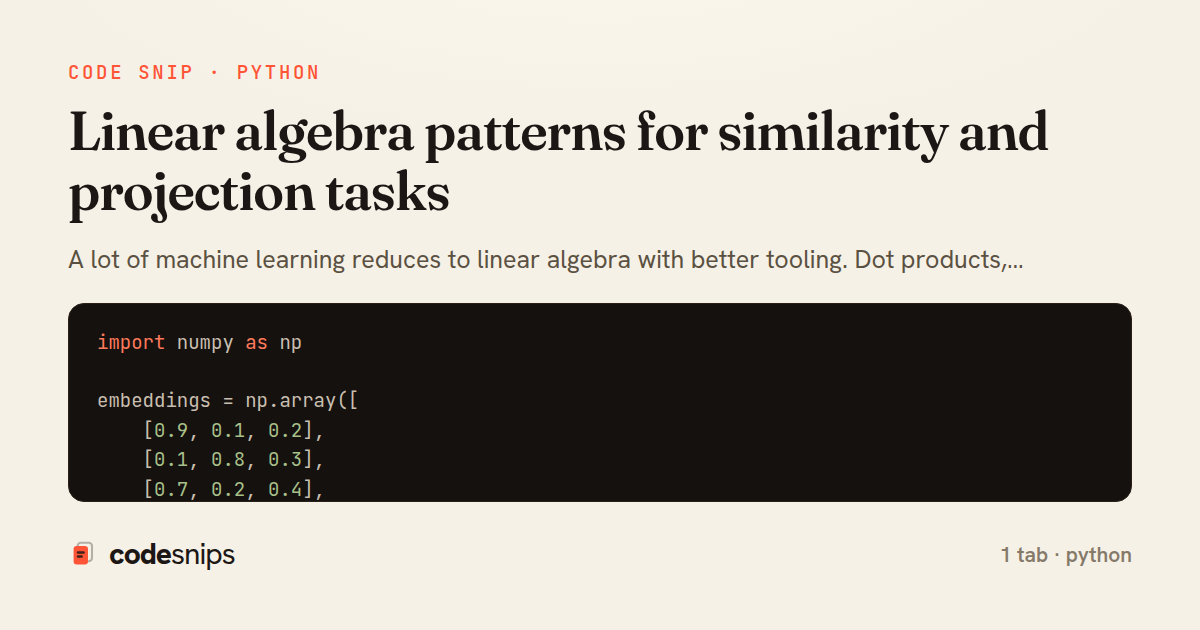
import numpy as np

embeddings = np.array([
    [0.9, 0.1, 0.2],
    [0.1, 0.8, 0.3],
    [0.7, 0.2, 0.4],
])

query = np.array([0.8, 0.2, 0.1])

normalized_embeddings = embeddings / np.linalg.norm(embeddings, axis=1, keepdims=True)
normalized_query = query / np.linalg.norm(query)

cosine_similarity = normalized_embeddings @ normalized_query
ranked_indices = np.argsort(cosine_similarity)[::-1]

print(cosine_similarity)
print(ranked_indices)
1 file · python
Explain with highlit
A lot of machine learning reduces to linear algebra with better tooling. Dot products, norms, matrix multiplication, and projections show up in recommendation, embeddings, PCA, and optimization. I keep the implementation small and testable so it stays understandable when somebody revisits it months later.
Related snips
python
from gensim.models import Word2Vec

sentences = [
    ['customer', 'refund', 'payment', 'issue'],
    ['login', 'authentication', 'password', 'reset'],
    ['delivery', 'shipment', 'tracking', 'delay'],
Word embeddings with gensim for semantic similarity tasks
word-embeddings
gensim
nlp
by Dr. Elena Vasquez
1 tab
python
import numpy as np

features = np.array([
    [120.0, 3.0, 10.0],
    [90.0, 5.0, 7.0],
    [150.0, 2.0, 14.0],
NumPy broadcasting for vectorized feature engineering
numpy
broadcasting
vectorization
by Dr. Elena Vasquez
1 tab
Share this code
Here's the card — post it anywhere.