python
23 lines · 1 tab
Dr. Elena Vasquez
Apr 2026
1 tab
import pandas as pd
import torch
from PIL import Image
from torch.utils.data import Dataset, DataLoader

class ProductImageDataset(Dataset):
    def __init__(self, metadata_path, image_root, transform=None):
        self.df = pd.read_csv(metadata_path)
        self.image_root = image_root
        self.transform = transform

    def __len__(self):
        return len(self.df)

    def __getitem__(self, index):
        row = self.df.iloc[index]
        image = Image.open(f"{self.image_root}/{row['image_name']}").convert('RGB')
        if self.transform:
            image = self.transform(image)
        label = torch.tensor(row['label'], dtype=torch.long)
        return image, label

train_loader = DataLoader(dataset=train_dataset, batch_size=64, shuffle=True, num_workers=4, pin_memory=True)
1 file · python
Explain with highlit
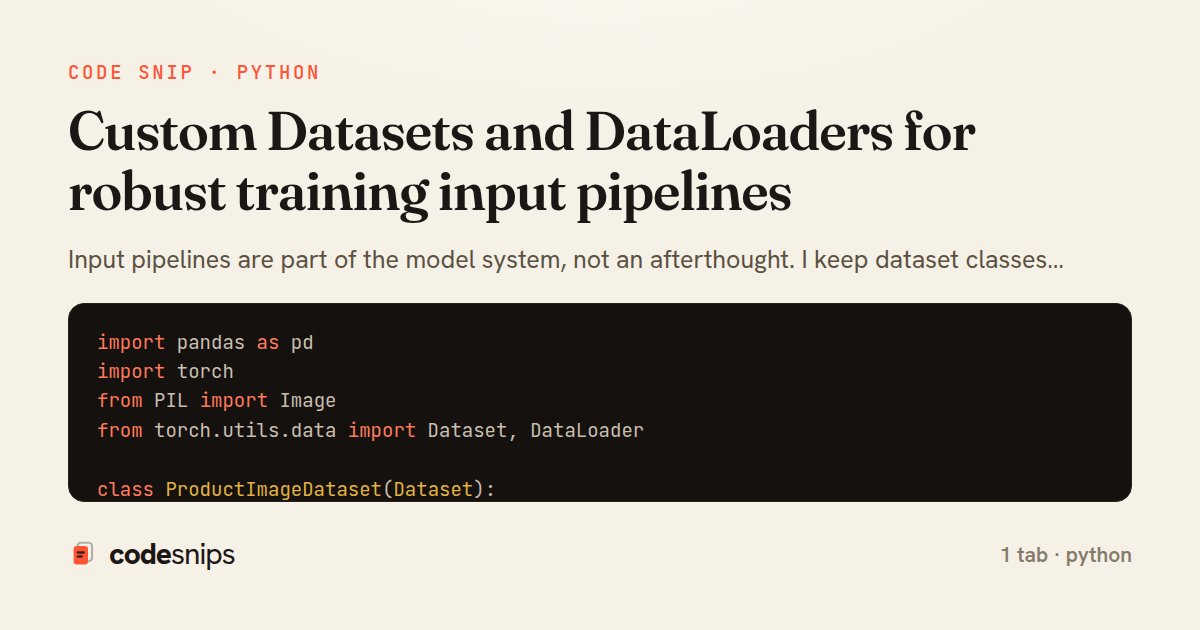
Input pipelines are part of the model system, not an afterthought. I keep dataset classes deterministic, move expensive transforms into explicit stages, and use DataLoader settings that match hardware limits. Good batching and collation logic can remove a surprising amount of GPU idle time.
Related snips
python
import torch.nn as nn

class SmallCNN(nn.Module):
    def __init__(self, num_classes: int) -> None:
        super().__init__()
        self.features = nn.Sequential(
Convolutional neural networks for image classification in PyTorch
pytorch
cnn
computer-vision
by Dr. Elena Vasquez
1 tab
typescript
import DataLoader from "dataloader";
import { Pool } from "pg";

export interface User { id: number; name: string; }
export interface Post { id: number; user_id: number; title: string; }
N+1 avoidance with DataLoader (GraphQL)
graphql
performance
dataloader
by codesnips
3 tabs
python
from typing import List, Optional

from sqlalchemy import select
from sqlalchemy.ext.asyncio import AsyncSession

from .dataloader import DataLoader
Batched DataLoader to Avoid N+1 Queries in FastAPI Responses
fastapi
dataloader
n-plus-one
by codesnips
3 tabs
ruby
# Gemfile
gem 'graphql'

# Installation
# rails generate graphql:install
GraphQL APIs with graphql-ruby gem
ruby
rails
graphql
by Sarah Mitchell
3 tabs
typescript
import { PrismaClient } from '@prisma/client';

const prisma = new PrismaClient();

export async function getFeedNaive(limit = 20) {
  const posts = await prisma.post.findMany({
Prisma: avoid N+1 with include/select
prisma
performance
typescript
by codesnips
3 tabs
python
import torch

best_val_loss = float('inf')

for epoch in range(1, num_epochs + 1):
    model.train()
A clean PyTorch training loop with validation and checkpoints
pytorch
training-loop
checkpoints
by Dr. Elena Vasquez
1 tab
Share this code
Here's the card — post it anywhere.