typescript
74 lines · 1 tab
Maya Patel
Jan 2026
1 tab
import React, { createContext, useContext, useState, useEffect, ReactNode } from 'react'
import { User } from '@/types'
import api from '@/services/api'

interface AuthContextType {
  user: User | null
  loading: boolean
  login: (email: string, password: string) => Promise<void>
  logout: () => void
  isAuthenticated: boolean
}

const AuthContext = createContext<AuthContextType | undefined>(undefined)

export function AuthProvider({ children }: { children: ReactNode }) {
  const [user, setUser] = useState<User | null>(null)
  const [loading, setLoading] = useState(true)

  useEffect(() => {
    const token = localStorage.getItem('authToken')
    if (token) {
      fetchCurrentUser()
    } else {
      setLoading(false)
    }
  }, [])

  const fetchCurrentUser = async () => {
    try {
      const { data } = await api.get<User>('/auth/me')
      setUser(data)
    } catch (error) {
      localStorage.removeItem('authToken')
    } finally {
      setLoading(false)
    }
  }

  const login = async (email: string, password: string) => {
    const { data } = await api.post<{ user: User; token: string }>('/auth/login', {
      email,
      password,
    })
    localStorage.setItem('authToken', data.token)
    setUser(data.user)
  }

  const logout = () => {
    localStorage.removeItem('authToken')
    setUser(null)
  }

  return (
    <AuthContext.Provider
      value={{
        user,
        loading,
        login,
        logout,
        isAuthenticated: !!user,
      }}
    >
      {children}
    </AuthContext.Provider>
  )
}

export function useAuth() {
  const context = useContext(AuthContext)
  if (context === undefined) {
    throw new Error('useAuth must be used within an AuthProvider')
  }
  return context
}
1 file · typescript
Explain with highlit
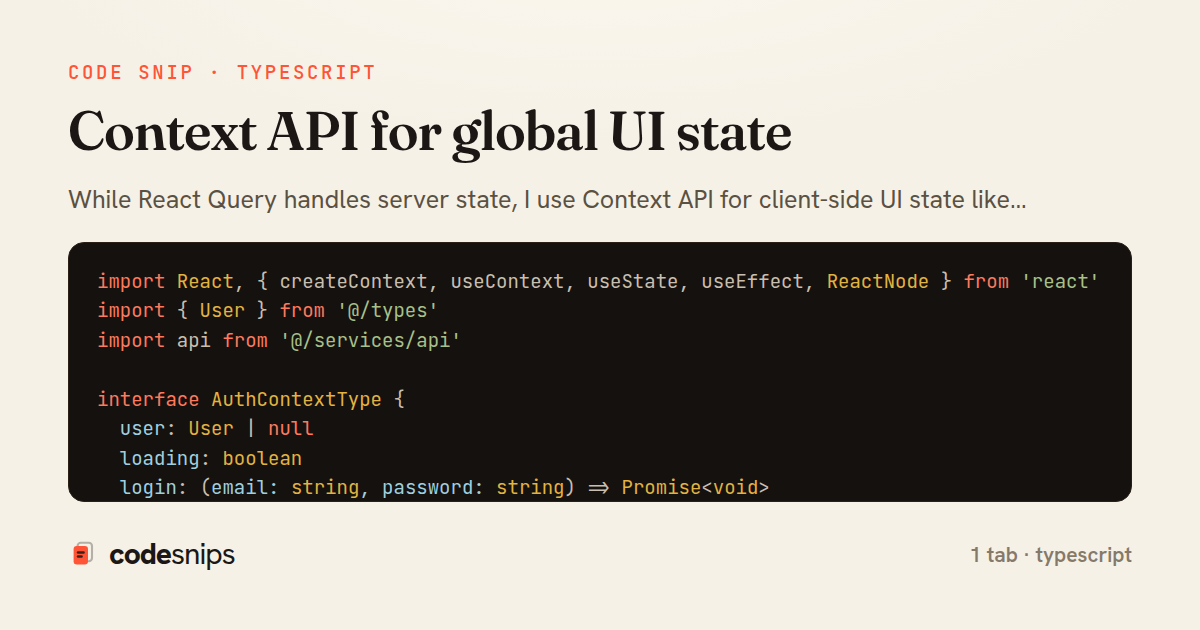
While React Query handles server state, I use Context API for client-side UI state like theme, sidebar visibility, or current user. Each context lives in its own file with a custom hook for consuming it. The context provider wraps the app at a high level and provides both state and updater functions. I avoid putting too much in context—only truly global state belongs here. For component-local state that's shared with a few children, prop drilling or composition is clearer. The useReducer hook works well for complex state transitions within a context. This pattern gives centralized state management without Redux's boilerplate for simple use cases.
Related snips
typescript
import axios, { AxiosError } from 'axios'
import { v4 as uuidv4 } from 'uuid'

const api = axios.create({
  baseURL: import.meta.env.VITE_API_URL || 'http://localhost:3000/api/v1',
  timeout: 15000,
Axios API client with interceptors
react
axios
api
by Maya Patel
1 tab
typescript
import { create } from 'zustand'
import { persist } from 'zustand/middleware'

interface FilterState {
  search: string
  category: string | null
Zustand for lightweight state management
react
zustand
state-management
by Maya Patel
2 tabs
swift
import SwiftUI

struct ContentView: View {
    @State private var username = ""
    @State private var isLoggedIn = false
    @StateObject private var viewModel = LoginViewModel()
SwiftUI declarative UI with state management
swift
swiftui
ios
by Sofia Martinez
2 tabs
typescript
import React from "react";

type FallbackProps = {
  error: Error;
  reset: () => void;
};
React Error Boundary + error reporting hook
react
frontend
error-boundary
by codesnips
3 tabs
javascript
const withBundleAnalyzer = require('@next/bundle-analyzer')({
  enabled: process.env.ANALYZE === 'true',
  openAnalyzer: true,
});

/** @type {import('next').NextConfig} */
Next.js bundle analyzer for targeted performance work
nextjs
performance
tooling
by codesnips
4 tabs
typescript
import { Navigate, useLocation } from 'react-router-dom'
import { useAuth } from '@/contexts/AuthContext'

interface ProtectedRouteProps {
  children: React.ReactNode
}
React Router with protected routes
react
react-router
routing
by Maya Patel
2 tabs
Share this code
Here's the card — post it anywhere.