rust
13 lines · 1 tab
Marcus Chen
Jan 2026
1 tab
use std::sync::mpsc;
use std::thread;

fn main() {
    let (tx, rx) = mpsc::channel();

    thread::spawn(move || {
        tx.send("hello from thread").unwrap();
    });

    let message = rx.recv().unwrap();
    println!("Received: {}", message);
}
1 file · rust
Explain with highlit
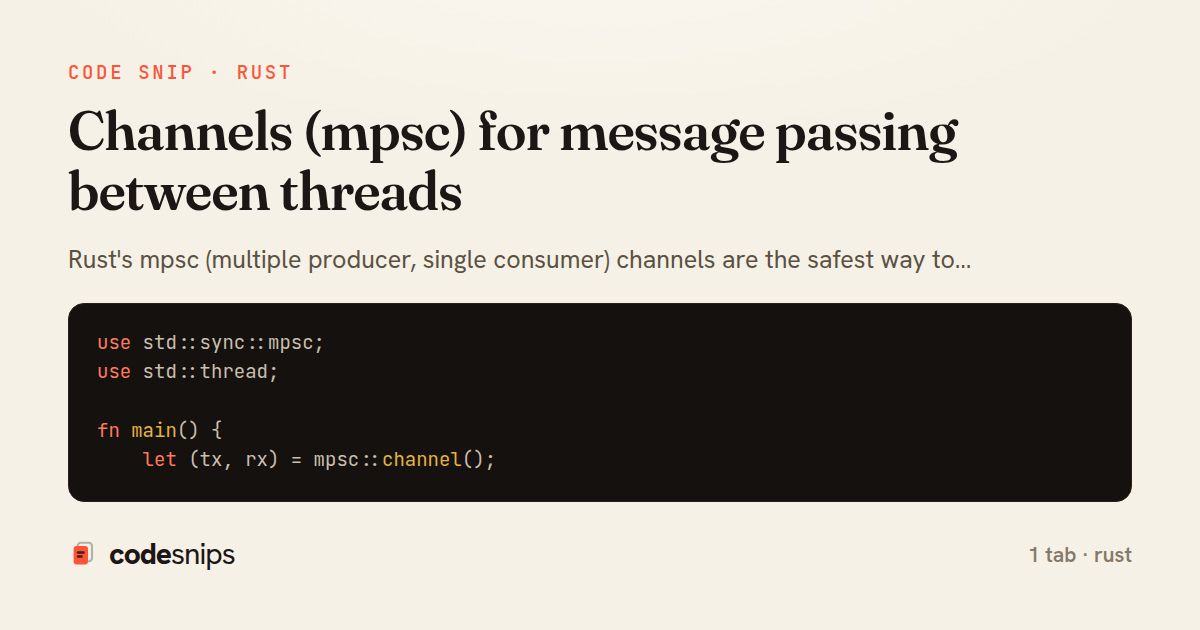
Rust's mpsc (multiple producer, single consumer) channels are the safest way to communicate between threads. You send owned values through the channel, transferring ownership to the receiver. This prevents data races because only one thread owns the data at a time. The sender can be cloned for multiple producers, and the receiver blocks or returns Err when all senders are dropped. I use channels for worker pools, event loops, and anywhere I need backpressure or decoupling. The pattern is similar to Go's channels but with Rust's ownership guarantees. For more complex topologies, I reach for crossbeam or tokio::sync, but mpsc covers most use cases and is part of the standard library.
Related snips
rust
struct Config<'a> {
    name: &'a str,
    value: &'a str,
}

fn parse_config(line: &str) -> Config {
Lifetime annotations for flexible borrowing in structs
rust
lifetimes
borrowing
by Marcus Chen
1 tab
javascript
// Creating a Promise
const myPromise = new Promise((resolve, reject) => {
  const success = true;

  setTimeout(() => {
    if (success) {
Promises and async/await patterns for asynchronous JavaScript
javascript
promises
async-await
by Alex Chang
1 tab
rust
use crossbeam::channel::unbounded;
use std::thread;

fn main() {
    let (tx, rx) = unbounded();
Crossbeam for advanced concurrent data structures
rust
concurrency
lock-free
by Marcus Chen
1 tab
rust
use tracing::{info, instrument};

#[instrument]
fn process_request(user_id: u64) {
    info!(user_id, "Processing request");
    // Work happens here
tracing for structured logging and distributed tracing
rust
observability
tracing
by Marcus Chen
1 tab
rust
use clap::Parser;

#[derive(Parser, Debug)]
#[command(author, version, about)]
struct Args {
    #[arg(short, long)]
clap for CLI argument parsing with derive macros
rust
cli
clap
by Marcus Chen
1 tab
typescript
export type Settled<R> =
  | { status: 'fulfilled'; value: R }
  | { status: 'rejected'; reason: unknown };

export interface ConcurrencyOptions {
  limit: number;
Simple concurrency limiter for batch operations
node
concurrency
async
by codesnips
2 tabs
Share this code
Here's the card — post it anywhere.