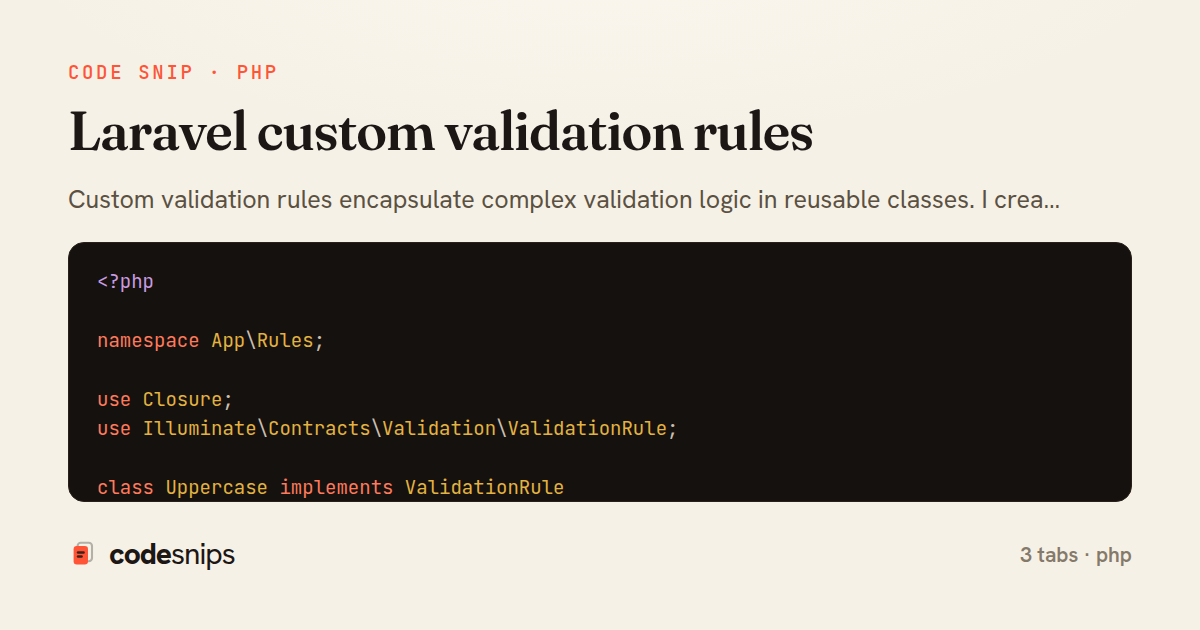
<?php

namespace App\Rules;

use Closure;
use Illuminate\Contracts\Validation\ValidationRule;

class Uppercase implements ValidationRule
{
    public function validate(string $attribute, mixed $value, Closure $fail): void
    {
        if ($value !== strtoupper($value)) {
            $fail("The {$attribute} must be uppercase.");
        }
    }
}
<?php

namespace App\Rules;

use App\Models\Coupon;
use Closure;
use Illuminate\Contracts\Validation\ValidationRule;

class ValidCoupon implements ValidationRule
{
    public function __construct(
        private ?int $userId = null
    ) {}

    public function validate(string $attribute, mixed $value, Closure $fail): void
    {
        $coupon = Coupon::where('code', $value)->first();

        if (!$coupon) {
            $fail('The coupon code is invalid.');
            return;
        }

        if ($coupon->expires_at && $coupon->expires_at->isPast()) {
            $fail('This coupon has expired.');
            return;
        }

        if ($coupon->max_uses && $coupon->times_used >= $coupon->max_uses) {
            $fail('This coupon has reached its usage limit.');
            return;
        }

        if ($this->userId && $coupon->hasBeenUsedBy($this->userId)) {
            $fail('You have already used this coupon.');
        }
    }
}
<?php

namespace App\Http\Requests;

use App\Rules\Uppercase;
use App\Rules\ValidCoupon;
use Illuminate\Foundation\Http\FormRequest;
use Illuminate\Validation\Rule;

class CheckoutRequest extends FormRequest
{
    public function rules(): array
    {
        return [
            'email' => ['required', 'email', Rule::unique('users')->ignore($this->user())],
            'coupon' => ['nullable', 'string', new ValidCoupon($this->user()?->id)],
            'country_code' => ['required', 'string', 'size:2', new Uppercase()],

            // Closure-based inline rule
            'quantity' => [
                'required',
                'integer',
                'min:1',
                function (string $attribute, mixed $value, Closure $fail) {
                    $product = Product::find($this->product_id);

                    if ($product && $value > $product->stock) {
                        $fail("Only {$product->stock} items available in stock.");
                    }
                },
            ],

            // Nested validation
            'items' => ['required', 'array', 'min:1'],
            'items.*.product_id' => ['required', 'exists:products,id'],
            'items.*.quantity' => ['required', 'integer', 'min:1'],
        ];
    }
}
Custom validation rules encapsulate complex validation logic in reusable classes. I create rule classes implementing ValidationRule with a validate() method receiving the attribute, value, and fail closure. Rules access databases, call APIs, or perform intricate checks. The Rule::unique()->ignore() pattern excludes current models during updates. Closure-based validation provides inline custom rules. The sometimes() method conditionally validates. Nested array validation uses dot notation. Custom error messages use translation keys. I combine rules with | or arrays. The validation system is extensible—perfect for business-specific constraints like checking inventory, validating coupons, or verifying external data.
Related snips
class SignupForm
  include ActiveModel::Model
  include ActiveModel::Attributes

  attribute :account_name, :string
  attribute :email, :string
Shallow Controller, Deep Params: Form Object Pattern
<?php

namespace App\Providers;

use App\Contracts\PaymentGateway;
use App\Services\StripePaymentGateway;
Laravel service container and dependency injection
<!DOCTYPE html>
<html lang="en">
<head>
  <meta charset="UTF-8">
  <title>Form Validation Example</title>
  <style>
HTML forms with validation and accessibility
{
  "private": true,
  "scripts": {
    "dev": "vite",
    "build": "vite build"
  },
Laravel mix/Vite for asset compilation
<?php

use Illuminate\Database\Migrations\Migration;
use Illuminate\Database\Schema\Blueprint;
use Illuminate\Support\Facades\Schema;
Laravel database migrations for schema management
import axios from 'axios';

export type NormalizedErrors = {
  fields: Record<string, string>;
  formLevel: string | null;
};
Frontend: normalize and display server validation errors
Share this code
Here's the card — post it anywhere.