php
89 lines · 3 tabs
Carlos Mendez
Jan 2026
3 tabs
<?php

use App\Models\Post;
use App\Models\Comment;
use Illuminate\Support\Facades\Route;

// Implicit binding - auto-resolves Post by ID
Route::get('/posts/{post}', function (Post $post) {
    return view('posts.show', compact('post'));
});

// Bind by slug instead of ID
Route::get('/posts/{post:slug}', function (Post $post) {
    return view('posts.show', compact('post'));
});

// Scoped binding - ensures comment belongs to post
Route::get('/posts/{post}/comments/{comment}', function (Post $post, Comment $comment) {
    return view('comments.show', compact('post', 'comment'));
})->scopeBindings();

// Include soft-deleted models
Route::get('/posts/{post}', function (Post $post) {
    return view('posts.show', compact('post'));
})->withTrashed();

// Custom missing behavior
Route::get('/posts/{post}', function (Post $post) {
    return view('posts.show', compact('post'));
})->missing(function () {
    return response()->view('errors.404', [], 404);
});
<?php

namespace App\Models;

use Illuminate\Database\Eloquent\Model;

class Post extends Model
{
    // Custom route key
    public function getRouteKeyName(): string
    {
        return 'slug';
    }

    // Customize resolution
    public function resolveRouteBinding($value, $field = null)
    {
        // Custom logic for resolving model
        return $this->where($field ?? $this->getRouteKeyName(), $value)
            ->published()
            ->firstOrFail();
    }

    public function scopePublished($query)
    {
        return $query->whereNotNull('published_at');
    }
}
<?php

namespace App\Providers;

use App\Models\Post;
use App\Models\User;
use Illuminate\Support\Facades\Route;
use Illuminate\Foundation\Support\Providers\RouteServiceProvider as ServiceProvider;

class RouteServiceProvider extends ServiceProvider
{
    public function boot(): void
    {
        // Explicit binding
        Route::bind('post', function ($value) {
            return Post::where('slug', $value)
                ->published()
                ->firstOrFail();
        });

        // Bind with custom model
        Route::model('admin', User::class);

        // Bind with callback
        Route::bind('user', function ($value) {
            return User::where('username', $value)->firstOrFail();
        });
    }
}
3 files · php
Explain with highlit
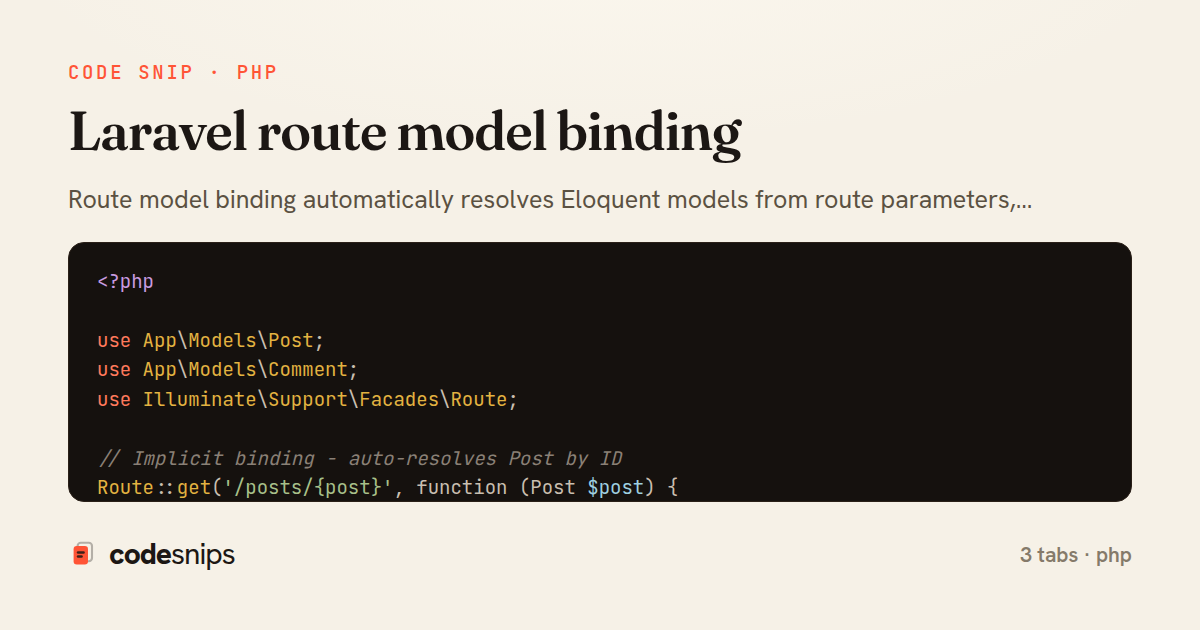
Route model binding automatically resolves Eloquent models from route parameters, eliminating manual lookups. Implicit binding matches parameter names to model IDs—/users/{user} injects the User model. Custom route keys use getRouteKeyName() to bind by slug instead of ID. Explicit binding in RouteServiceProvider provides full control over resolution logic. Soft-deleted models are excluded unless using withTrashed(). Scoped bindings enforce parent-child relationships—/posts/{post}/comments/{comment} ensures the comment belongs to the post. Missing models return 404 automatically. This feature reduces boilerplate and improves security by centralizing authorization checks.
Related snips
python
from django.urls import path
from . import views

app_name = 'blog'

urlpatterns = [
Django URL namespacing and reverse lookups
django
python
urls
by Priya Sharma
3 tabs
php
<?php

namespace App\Providers;

use App\Contracts\PaymentGateway;
use App\Services\StripePaymentGateway;
Laravel service container and dependency injection
laravel
dependency-injection
service-container
by Carlos Mendez
2 tabs
json
{
  "private": true,
  "scripts": {
    "dev": "vite",
    "build": "vite build"
  },
Laravel mix/Vite for asset compilation
laravel
vite
assets
by Carlos Mendez
4 tabs
php
<?php

use Illuminate\Database\Migrations\Migration;
use Illuminate\Database\Schema\Blueprint;
use Illuminate\Support\Facades\Schema;
Laravel database migrations for schema management
laravel
migrations
database
by Carlos Mendez
3 tabs
typescript
import { Navigate, useLocation } from 'react-router-dom'
import { useAuth } from '@/contexts/AuthContext'

interface ProtectedRouteProps {
  children: React.ReactNode
}
React Router with protected routes
react
react-router
routing
by Maya Patel
2 tabs
php
<?php

namespace App\Http\Requests;

use Illuminate\Foundation\Http\FormRequest;
use Illuminate\Validation\Rule;
Laravel form requests for validation
laravel
validation
form-requests
by Carlos Mendez
2 tabs
Share this code
Here's the card — post it anywhere.