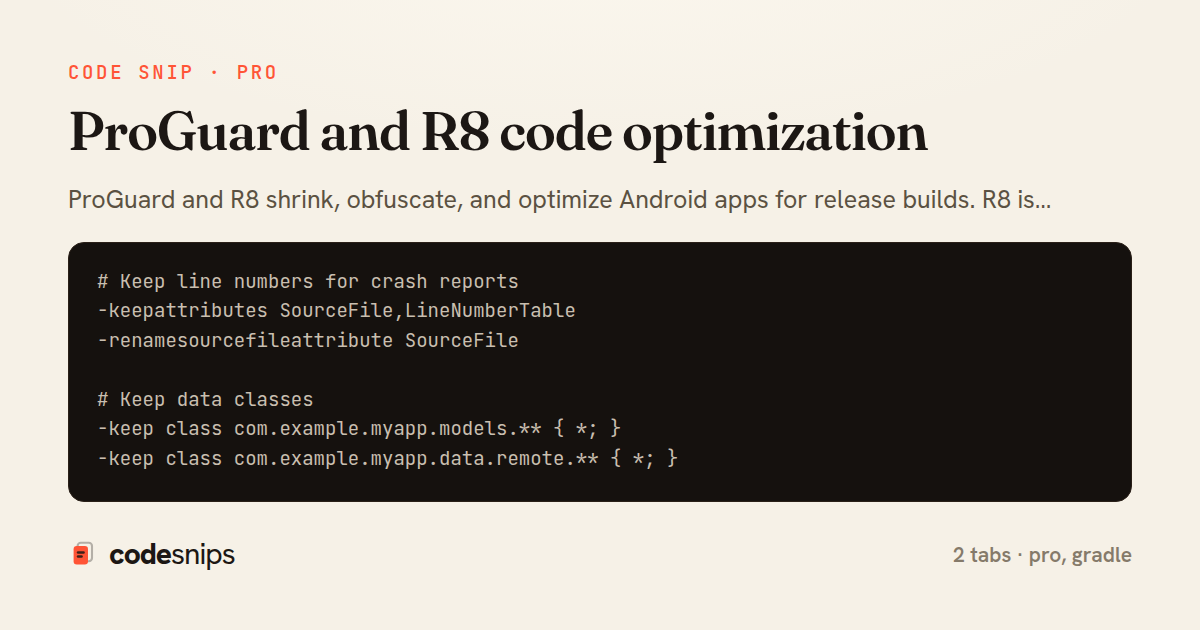
# Keep line numbers for crash reports
-keepattributes SourceFile,LineNumberTable
-renamesourcefileattribute SourceFile

# Keep data classes
-keep class com.example.myapp.models.** { *; }
-keep class com.example.myapp.data.remote.** { *; }

# Keep Parcelable implementations
-keepclassmembers class * implements android.os.Parcelable {
    public static final ** CREATOR;
}

# Keep Serializable classes
-keepclassmembers class * implements java.io.Serializable {
    private static final java.io.ObjectStreamField[] serialPersistentFields;
    private void writeObject(java.io.ObjectOutputStream);
    private void readObject(java.io.ObjectInputStream);
    java.lang.Object writeReplace();
    java.lang.Object readResolve();
}

# Retrofit
-keepattributes Signature, InnerClasses, EnclosingMethod
-keepattributes RuntimeVisibleAnnotations, RuntimeVisibleParameterAnnotations
-keepclassmembers,allowshrinking,allowobfuscation interface * {
    @retrofit2.http.* <methods>;
}

# Moshi
-keepclasseswithmembers class * {
    @com.squareup.moshi.* <methods>;
}
-keep @com.squareup.moshi.JsonQualifier interface *
-keepclassmembers class kotlin.Metadata {
    public <methods>;
}

# Kotlin Coroutines
-keepnames class kotlinx.coroutines.internal.MainDispatcherFactory {}
-keepnames class kotlinx.coroutines.CoroutineExceptionHandler {}
-keepclassmembernames class kotlinx.** {
    volatile <fields>;
}

# Glide
-keep public class * implements com.bumptech.glide.module.GlideModule
-keep class * extends com.bumptech.glide.module.AppGlideModule {
    <init>(...);
}
-keep public enum com.bumptech.glide.load.ImageHeaderParser$** {
    **[] $VALUES;
    public *;
}

# Room
-keep class * extends androidx.room.RoomDatabase
-keep @androidx.room.Entity class *
-dontwarn androidx.room.paging.**

# Keep custom views
-keep public class * extends android.view.View {
    public <init>(android.content.Context);
    public <init>(android.content.Context, android.util.AttributeSet);
    public <init>(android.content.Context, android.util.AttributeSet, int);
}

# Keep enum values
-keepclassmembers enum * {
    public static **[] values();
    public static ** valueOf(java.lang.String);
}

# Remove logging in release
-assumenosideeffects class android.util.Log {
    public static *** d(...);
    public static *** v(...);
    public static *** i(...);
}

# Keep native methods
-keepclasseswithmembernames class * {
    native <methods>;
}

# Firebase
-keepattributes *Annotation*
-keepattributes Signature
-keep class com.google.firebase.** { *; }
android {
    buildTypes {
        release {
            minifyEnabled true
            shrinkResources true
            proguardFiles getDefaultProguardFile('proguard-android-optimize.txt'), 'proguard-rules.pro'

            // Keep debug symbols for crash reports
            debuggable false

            // Generate mapping file
            proguardFiles 'proguard-rules.pro'
        }

        debug {
            minifyEnabled false
            debuggable true
        }
    }
}
ProGuard and R8 shrink, obfuscate, and optimize Android apps for release builds. R8 is the default tool, combining shrinking and desugaring. I configure rules in proguard-rules.pro—keeping classes used by reflection, serialization, or native code. -keep preserves classes and members, -keepnames keeps names but allows shrinking. Obfuscation renames classes/methods making reverse engineering harder. Optimization removes unused code and inlines methods. Source file and line numbers mapping enables crash report deobfuscation with mapping.txt. Data classes, Parcelable, and library-specific rules require careful configuration. Testing release builds catches configuration issues. Proper ProGuard setup reduces APK size significantly while protecting intellectual property.
Related snips
package com.example.myapp

import android.app.Application
import dagger.hilt.android.HiltAndroidApp

@HiltAndroidApp
Dependency injection with Hilt
package com.example.myapp.ui

import androidx.lifecycle.*
import kotlinx.coroutines.launch

class UserViewModel(
LiveData transformations and mediators
# BAD: N+1 query problem
@users = User.all
@users.each do |user|
  puts user.posts.count  # Fires query for each user!
end
ActiveRecord query optimization and N+1 prevention
-- EXPLAIN ANALYZE (actual execution statistics)
EXPLAIN ANALYZE
SELECT u.username, COUNT(o.id) AS order_count
FROM users u
LEFT JOIN orders o ON u.id = o.user_id
WHERE u.created_at >= '2024-01-01'
Advanced query optimization techniques
package com.example.myapp.utils

import android.os.Build
import android.os.StrictMode
import android.os.Trace
import timber.log.Timber
Performance optimization and profiling
const withBundleAnalyzer = require('@next/bundle-analyzer')({
  enabled: process.env.ANALYZE === 'true',
  openAnalyzer: true,
});

/** @type {import('next').NextConfig} */
Next.js bundle analyzer for targeted performance work
Share this code
Here's the card — post it anywhere.