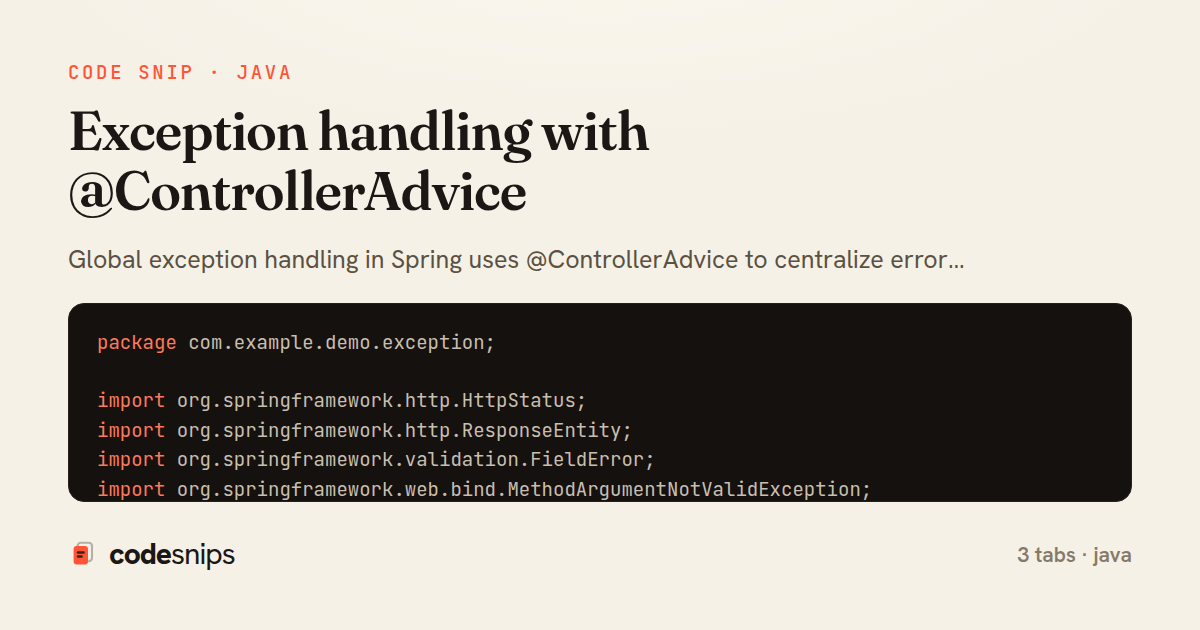
package com.example.demo.exception;

import org.springframework.http.HttpStatus;
import org.springframework.http.ResponseEntity;
import org.springframework.validation.FieldError;
import org.springframework.web.bind.MethodArgumentNotValidException;
import org.springframework.web.bind.annotation.ControllerAdvice;
import org.springframework.web.bind.annotation.ExceptionHandler;
import org.springframework.web.context.request.WebRequest;

import java.time.LocalDateTime;
import java.util.HashMap;
import java.util.Map;

@ControllerAdvice
public class GlobalExceptionHandler {

    @ExceptionHandler(ResourceNotFoundException.class)
    public ResponseEntity<ErrorResponse> handleResourceNotFound(
        ResourceNotFoundException ex,
        WebRequest request
    ) {
        ErrorResponse error = new ErrorResponse(
            HttpStatus.NOT_FOUND.value(),
            ex.getMessage(),
            request.getDescription(false),
            LocalDateTime.now()
        );
        return new ResponseEntity<>(error, HttpStatus.NOT_FOUND);
    }

    @ExceptionHandler(BadRequestException.class)
    public ResponseEntity<ErrorResponse> handleBadRequest(
        BadRequestException ex,
        WebRequest request
    ) {
        ErrorResponse error = new ErrorResponse(
            HttpStatus.BAD_REQUEST.value(),
            ex.getMessage(),
            request.getDescription(false),
            LocalDateTime.now()
        );
        return new ResponseEntity<>(error, HttpStatus.BAD_REQUEST);
    }

    @ExceptionHandler(MethodArgumentNotValidException.class)
    public ResponseEntity<ValidationErrorResponse> handleValidationErrors(
        MethodArgumentNotValidException ex
    ) {
        Map<String, String> errors = new HashMap<>();
        ex.getBindingResult().getAllErrors().forEach((error) -> {
            String fieldName = ((FieldError) error).getField();
            String errorMessage = error.getDefaultMessage();
            errors.put(fieldName, errorMessage);
        });

        ValidationErrorResponse response = new ValidationErrorResponse(
            HttpStatus.BAD_REQUEST.value(),
            "Validation failed",
            errors,
            LocalDateTime.now()
        );

        return new ResponseEntity<>(response, HttpStatus.BAD_REQUEST);
    }

    @ExceptionHandler(DuplicateResourceException.class)
    public ResponseEntity<ErrorResponse> handleDuplicateResource(
        DuplicateResourceException ex,
        WebRequest request
    ) {
        ErrorResponse error = new ErrorResponse(
            HttpStatus.CONFLICT.value(),
            ex.getMessage(),
            request.getDescription(false),
            LocalDateTime.now()
        );
        return new ResponseEntity<>(error, HttpStatus.CONFLICT);
    }

    @ExceptionHandler(UnauthorizedException.class)
    public ResponseEntity<ErrorResponse> handleUnauthorized(
        UnauthorizedException ex,
        WebRequest request
    ) {
        ErrorResponse error = new ErrorResponse(
            HttpStatus.UNAUTHORIZED.value(),
            ex.getMessage(),
            request.getDescription(false),
            LocalDateTime.now()
        );
        return new ResponseEntity<>(error, HttpStatus.UNAUTHORIZED);
    }

    @ExceptionHandler(Exception.class)
    public ResponseEntity<ErrorResponse> handleGlobalException(
        Exception ex,
        WebRequest request
    ) {
        ErrorResponse error = new ErrorResponse(
            HttpStatus.INTERNAL_SERVER_ERROR.value(),
            "An unexpected error occurred",
            request.getDescription(false),
            LocalDateTime.now()
        );
        // Log the full exception for debugging
        ex.printStackTrace();
        return new ResponseEntity<>(error, HttpStatus.INTERNAL_SERVER_ERROR);
    }
}
package com.example.demo.exception;

import java.time.LocalDateTime;
import java.util.Map;

public class ErrorResponse {
    private int status;
    private String message;
    private String path;
    private LocalDateTime timestamp;

    public ErrorResponse(int status, String message, String path, LocalDateTime timestamp) {
        this.status = status;
        this.message = message;
        this.path = path;
        this.timestamp = timestamp;
    }

    // Getters and setters
    public int getStatus() { return status; }
    public void setStatus(int status) { this.status = status; }

    public String getMessage() { return message; }
    public void setMessage(String message) { this.message = message; }

    public String getPath() { return path; }
    public void setPath(String path) { this.path = path; }

    public LocalDateTime getTimestamp() { return timestamp; }
    public void setTimestamp(LocalDateTime timestamp) { this.timestamp = timestamp; }
}

class ValidationErrorResponse extends ErrorResponse {
    private Map<String, String> errors;

    public ValidationErrorResponse(
        int status,
        String message,
        Map<String, String> errors,
        LocalDateTime timestamp
    ) {
        super(status, message, "", timestamp);
        this.errors = errors;
    }

    public Map<String, String> getErrors() { return errors; }
    public void setErrors(Map<String, String> errors) { this.errors = errors; }
}
package com.example.demo.exception;

import org.springframework.http.HttpStatus;
import org.springframework.web.bind.annotation.ResponseStatus;

@ResponseStatus(HttpStatus.NOT_FOUND)
public class ResourceNotFoundException extends RuntimeException {
    public ResourceNotFoundException(String message) {
        super(message);
    }

    public ResourceNotFoundException(String resourceName, String fieldName, Object fieldValue) {
        super(String.format("%s not found with %s: '%s'", resourceName, fieldName, fieldValue));
    }
}

@ResponseStatus(HttpStatus.BAD_REQUEST)
class BadRequestException extends RuntimeException {
    public BadRequestException(String message) {
        super(message);
    }
}

@ResponseStatus(HttpStatus.CONFLICT)
class DuplicateResourceException extends RuntimeException {
    public DuplicateResourceException(String message) {
        super(message);
    }
}

@ResponseStatus(HttpStatus.UNAUTHORIZED)
class UnauthorizedException extends RuntimeException {
    public UnauthorizedException(String message) {
        super(message);
    }
}
Global exception handling in Spring uses @ControllerAdvice to centralize error responses across all controllers. I define @ExceptionHandler methods for specific exceptions, returning consistent error DTOs with HTTP status codes. Custom exceptions extend RuntimeException for business logic violations. @ResponseStatus annotations set default status codes. The advice intercepts exceptions before they reach the client, transforming them into user-friendly JSON responses. Validation errors from @Valid trigger MethodArgumentNotValidException, which I handle to return field-specific messages. This pattern eliminates try-catch blocks in controllers and ensures uniform error handling. Logging integration captures exceptions for monitoring. The approach separates error handling concerns from business logic, improving maintainability.
Related snips
type User {
    id: ID!
    name: String!
    email: String!
    posts: [Post!]!
    createdAt: String!
GraphQL API with Spring Boot
package com.example.starter.config;

import com.example.starter.properties.CustomProperties;
import com.example.starter.service.CustomService;
import org.springframework.boot.autoconfigure.AutoConfiguration;
import org.springframework.boot.autoconfigure.condition.ConditionalOnClass;
Custom Spring Boot starters
package com.example.demo.config;

import org.apache.kafka.clients.consumer.ConsumerConfig;
import org.apache.kafka.clients.producer.ProducerConfig;
import org.apache.kafka.common.serialization.StringDeserializer;
import org.apache.kafka.common.serialization.StringSerializer;
Messaging with Apache Kafka
module Paginatable
  extend ActiveSupport::Concern

  MAX_PER_PAGE = 100
  DEFAULT_PER_PAGE = 25
API Pagination Headers (Link + Total)
package com.example.demo.controller;

import com.example.demo.dto.FileMetadata;
import com.example.demo.service.FileStorageService;
import org.springframework.core.io.Resource;
import org.springframework.http.HttpHeaders;
File upload and download handling
CREATE TABLE users (
    id BIGSERIAL PRIMARY KEY,
    username VARCHAR(100) NOT NULL UNIQUE,
    email VARCHAR(255) NOT NULL UNIQUE,
    password VARCHAR(255) NOT NULL,
    created_at TIMESTAMP NOT NULL DEFAULT CURRENT_TIMESTAMP,
Database migration with Flyway
Share this code
Here's the card — post it anywhere.