ruby
208 lines · 3 tabs
Sarah Mitchell
Feb 2026
3 tabs
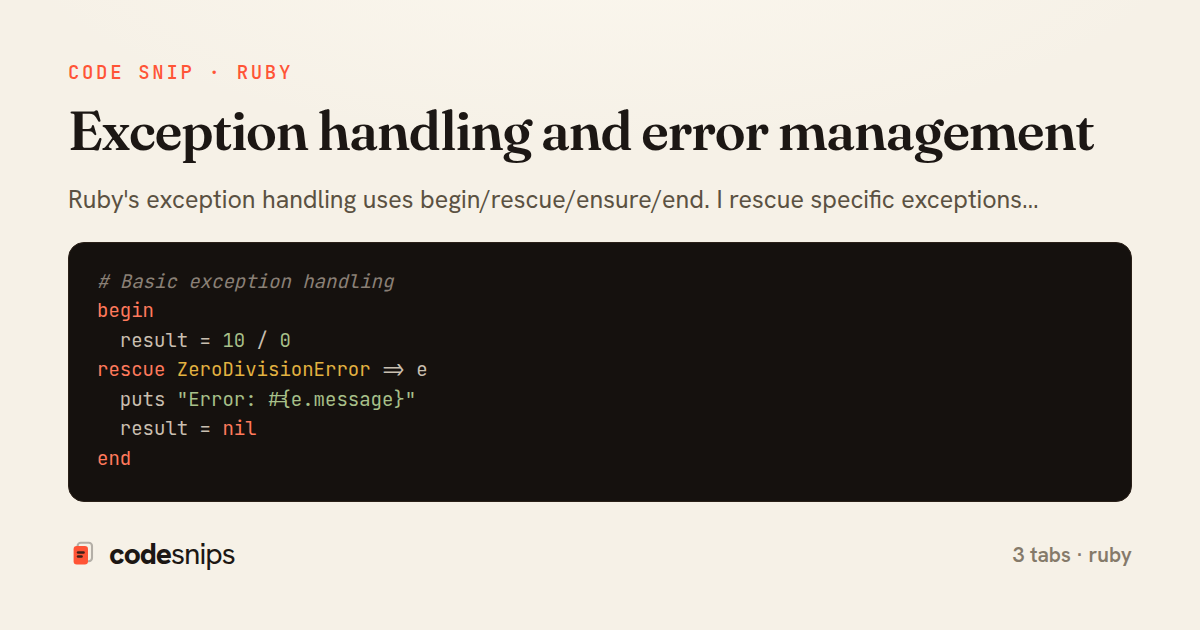
# Basic exception handling
begin
  result = 10 / 0
rescue ZeroDivisionError => e
  puts "Error: #{e.message}"
  result = nil
end

# Multiple rescue clauses
begin
  # Risky operation
  file = File.open('nonexistent.txt')
rescue Errno::ENOENT => e
  puts "File not found: #{e.message}"
rescue IOError => e
  puts "IO Error: #{e.message}"
rescue StandardError => e
  puts "Standard error: #{e.message}"
ensure
  # Always runs, even if exception occurs
  file&.close
end

# Rescue and retry
attempts = 0
begin
  attempts += 1
  # Network call that might fail
  response = HTTParty.get('https://api.example.com/data')
rescue Net::OpenTimeout, Net::ReadTimeout => e
  if attempts < 3
    sleep(2 ** attempts)  # Exponential backoff
    retry
  else
    raise  # Re-raise after max attempts
  end
end

# Inline rescue
value = risky_method rescue default_value
user = User.find(params[:id]) rescue nil

# Rescue in methods (implicit begin)
def fetch_user(id)
  User.find(id)
rescue ActiveRecord::RecordNotFound
  User.new(name: 'Guest')
end

# Raising exceptions
raise "Something went wrong"
raise ArgumentError, "Invalid argument"
raise ArgumentError.new("Invalid argument")

# Re-raising with modification
begin
  # Operation
rescue StandardError => e
  raise StandardError, "Failed: #{e.message}", e.backtrace
end
# Custom exception classes
class ApplicationError < StandardError; end
class AuthenticationError < ApplicationError; end
class AuthorizationError < ApplicationError; end
class ValidationError < ApplicationError
  attr_reader :errors

  def initialize(errors)
    @errors = errors
    super("Validation failed: #{errors.join(', ')}")
  end
end

# Usage
def authenticate_user(credentials)
  raise AuthenticationError, "Invalid credentials" unless valid?(credentials)
  # Authentication logic
end

def authorize_user(user, action)
  raise AuthorizationError, "Not authorized to #{action}" unless user.can?(action)
  # Authorization logic
end

def validate_input(data)
  errors = []
  errors << "Name is required" if data[:name].blank?
  errors << "Email is invalid" unless data[:email]&.match?(/@/)

  raise ValidationError.new(errors) if errors.any?
end

# Catching custom exceptions
begin
  validate_input(params)
rescue ValidationError => e
  render json: { errors: e.errors }, status: :unprocessable_entity
rescue AuthenticationError => e
  render json: { error: e.message }, status: :unauthorized
rescue AuthorizationError => e
  render json: { error: e.message }, status: :forbidden
end

# Exception with custom data
class APIError < StandardError
  attr_reader :status_code, :response_body

  def initialize(message, status_code:, response_body: nil)
    @status_code = status_code
    @response_body = response_body
    super(message)
  end
end

# Usage
raise APIError.new(
  "API request failed",
  status_code: 500,
  response_body: { error: "Internal error" }
)
# Exception translation pattern
class ExternalAPIClient
  class APIError < StandardError; end
  class NotFoundError < APIError; end
  class RateLimitError < APIError; end

  def fetch_data(id)
    response = HTTParty.get("https://api.example.com/items/#{id}")

    case response.code
    when 200
      response.parsed_response
    when 404
      raise NotFoundError, "Item #{id} not found"
    when 429
      raise RateLimitError, "Rate limit exceeded"
    else
      raise APIError, "Request failed with status #{response.code}"
    end
  rescue HTTParty::Error => e
    raise APIError, "HTTP error: #{e.message}"
  end
end

# Circuit breaker pattern
class CircuitBreaker
  class CircuitOpenError < StandardError; end

  def initialize(threshold: 5, timeout: 60)
    @failure_count = 0
    @threshold = threshold
    @timeout = timeout
    @last_failure_time = nil
    @state = :closed
  end

  def call
    raise CircuitOpenError if open?

    yield
    on_success
  rescue StandardError => e
    on_failure
    raise
  end

  private

  def open?
    @state == :open && Time.now - @last_failure_time < @timeout
  end

  def on_success
    @failure_count = 0
    @state = :closed
  end

  def on_failure
    @failure_count += 1
    @last_failure_time = Time.now
    @state = :open if @failure_count >= @threshold
  end
end

# Safe navigation with exceptions
def safe_find(model, id)
  model.find(id)
rescue ActiveRecord::RecordNotFound
  nil
end

# Exception logging
begin
  dangerous_operation
rescue StandardError => e
  Rails.logger.error("Operation failed: #{e.class.name} - #{e.message}")
  Rails.logger.error(e.backtrace.join("\n"))

  # Report to error tracking service
  Sentry.capture_exception(e)

  raise
end

# Suppressing exceptions (use sparingly!)
suppress(Errno::ENOENT) do
  File.delete('tmp/cache.dat')
end
3 files · ruby
Explain with highlit
Ruby's exception handling uses begin/rescue/ensure/end. I rescue specific exceptions before general ones. rescue catches exceptions; ensure runs cleanup code always. retry attempts operation again; raise re-raises exceptions. Custom exceptions inherit from StandardError. Multiple rescue clauses handle different error types. Exception messages and backtraces aid debugging. I use inline rescue for simple cases—value = risky_method rescue default_value. Rescue modifiers catch and suppress errors—useful but potentially dangerous. Exception handling enables graceful degradation. Proper error management improves robustness and user experience. Understanding Ruby's exception hierarchy guides rescue strategies.
Related snips
ruby
class Money
  include Comparable

  attr_reader :amount, :currency

  def initialize(amount, currency = 'USD')
Value objects for domain modeling
ruby
value-objects
domain-driven-design
by Sarah Mitchell
2 tabs
javascript
// Creating a Promise
const myPromise = new Promise((resolve, reject) => {
  const success = true;

  setTimeout(() => {
    if (success) {
Promises and async/await patterns for asynchronous JavaScript
javascript
promises
async-await
by Alex Chang
1 tab
ruby
# app/mailers/user_mailer.rb
class UserMailer < ApplicationMailer
  default from: 'noreply@example.com'

  def welcome_email(user)
    @user = user
ActionMailer advanced patterns for transactional emails
ruby
rails
action-mailer
by Sarah Mitchell
2 tabs
ruby
# BAD: N+1 query problem
@users = User.all
@users.each do |user|
  puts user.posts.count  # Fires query for each user!
end
ActiveRecord query optimization and N+1 prevention
ruby
rails
activerecord
by Sarah Mitchell
3 tabs
ruby
# Installation
# rails active_storage:install
# rails db:migrate

# config/storage.yml
local:
ActiveStorage for file uploads and attachments
ruby
rails
active-storage
by Sarah Mitchell
2 tabs
ruby
class CreateDeadJobs < ActiveRecord::Migration[7.1]
  def change
    create_table :dead_jobs do |t|
      t.string  :jid, null: false
      t.string  :queue, null: false
      t.string  :klass, null: false
Background Job Dead Letter Queue (DLQ) Table
rails
reliability
background-jobs
by codesnips
4 tabs
Share this code
Here's the card — post it anywhere.