rust
8 lines · 1 tab
Marcus Chen
Jan 2026
1 tab
use std::fs;
use std::num::ParseIntError;

fn read_port(path: &str) -> Result<u16, Box<dyn std::error::Error>> {
    let contents = fs::read_to_string(path)?;
    let port: u16 = contents.trim().parse()?;
    Ok(port)
}
1 file · rust
Explain with highlit
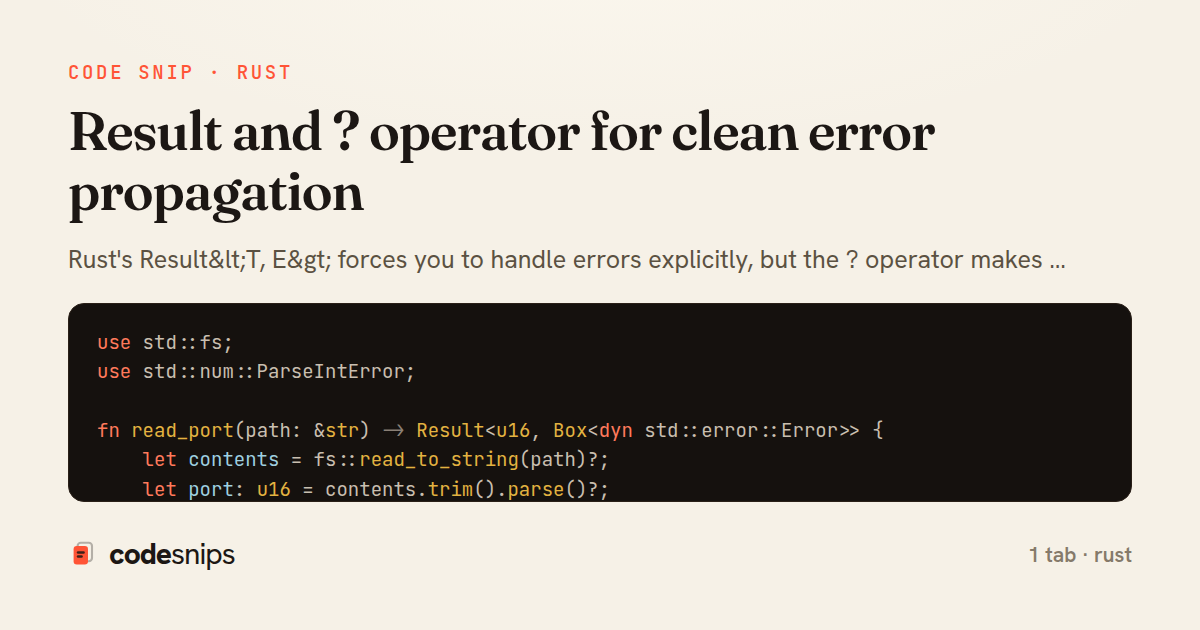
Rust's Result<T, E> forces you to handle errors explicitly, but the ? operator makes it ergonomic. When a function returns Result, using ? automatically returns early with the error if it's Err, or unwraps the value if it's Ok. This replaces verbose match or unwrap() chains. The key is that ? only works in functions that return Result or Option, which keeps error handling explicit at boundaries. I use this everywhere: file I/O, parsing, network calls. It reads sequentially like exceptions but without hidden control flow. The compiler ensures you can't ignore errors, and the calling code decides how to handle them. This is one of Rust's killer features for reliability.
Related snips
rust
struct Config<'a> {
    name: &'a str,
    value: &'a str,
}

fn parse_config(line: &str) -> Config {
Lifetime annotations for flexible borrowing in structs
rust
lifetimes
borrowing
by Marcus Chen
1 tab
javascript
// Creating a Promise
const myPromise = new Promise((resolve, reject) => {
  const success = true;

  setTimeout(() => {
    if (success) {
Promises and async/await patterns for asynchronous JavaScript
javascript
promises
async-await
by Alex Chang
1 tab
rust
use crossbeam::channel::unbounded;
use std::thread;

fn main() {
    let (tx, rx) = unbounded();
Crossbeam for advanced concurrent data structures
rust
concurrency
lock-free
by Marcus Chen
1 tab
rust
use tracing::{info, instrument};

#[instrument]
fn process_request(user_id: u64) {
    info!(user_id, "Processing request");
    // Work happens here
tracing for structured logging and distributed tracing
rust
observability
tracing
by Marcus Chen
1 tab
rust
use std::sync::mpsc;
use std::thread;

fn main() {
    let (tx, rx) = mpsc::channel();
Channels (mpsc) for message passing between threads
rust
concurrency
channels
by Marcus Chen
1 tab
rust
use clap::Parser;

#[derive(Parser, Debug)]
#[command(author, version, about)]
struct Args {
    #[arg(short, long)]
clap for CLI argument parsing with derive macros
rust
cli
clap
by Marcus Chen
1 tab
Share this code
Here's the card — post it anywhere.