use anyhow::{Context, Result};
use std::fs;

fn load_config(path: &str) -> Result<String> {
    fs::read_to_string(path)
        .with_context(|| format!("failed to read config from {}", path))
}

fn main() -> Result<()> {
    let config = load_config("config.toml")?;
    println!("Loaded config: {}", config);
    Ok(())
}
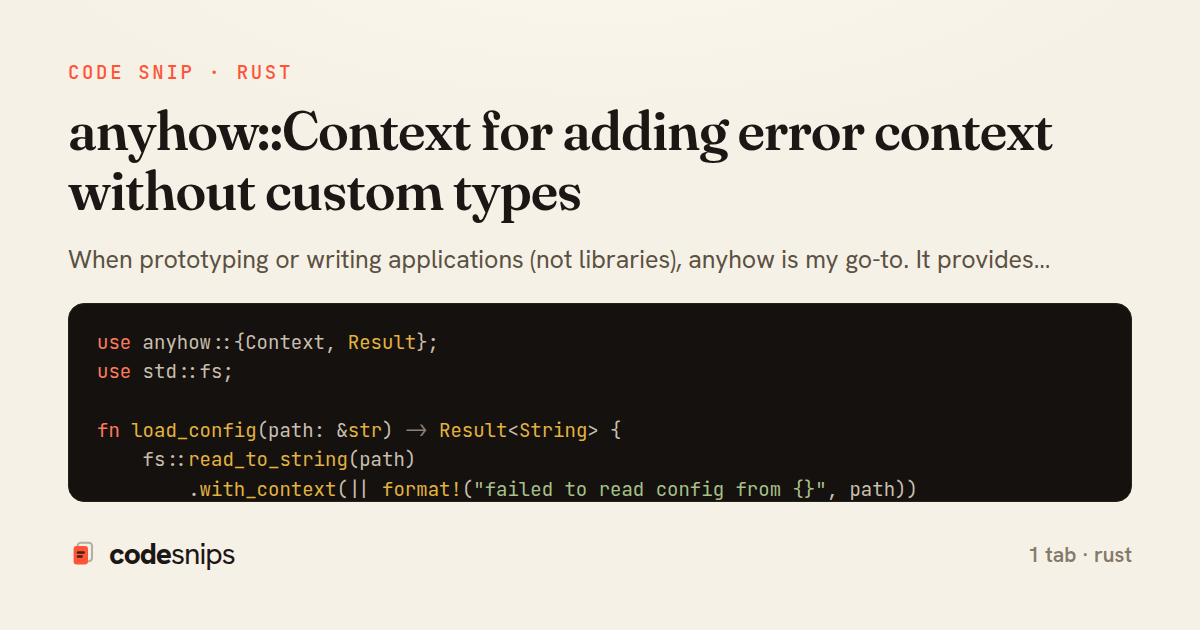
When prototyping or writing applications (not libraries), anyhow is my go-to. It provides Result<T> as an alias for Result<T, anyhow::Error>, which can hold any error type. The .context() method attaches additional context to errors as they propagate, which is invaluable for debugging. You can chain context at each layer without defining custom error enums. This keeps code concise while still providing rich error messages. The downside is you lose compile-time error matching, so I only use it in binaries where error handling is mostly "log and exit." For libraries, I still prefer thiserror for typed errors. But for CLI tools and services where you want fast iteration and good diagnostics, anyhow is unbeatable.
Related snips
struct Config<'a> {
    name: &'a str,
    value: &'a str,
}

fn parse_config(line: &str) -> Config {
Lifetime annotations for flexible borrowing in structs
// Creating a Promise
const myPromise = new Promise((resolve, reject) => {
  const success = true;

  setTimeout(() => {
    if (success) {
Promises and async/await patterns for asynchronous JavaScript
use crossbeam::channel::unbounded;
use std::thread;

fn main() {
    let (tx, rx) = unbounded();
Crossbeam for advanced concurrent data structures
use tracing::{info, instrument};

#[instrument]
fn process_request(user_id: u64) {
    info!(user_id, "Processing request");
    // Work happens here
tracing for structured logging and distributed tracing
use std::sync::mpsc;
use std::thread;

fn main() {
    let (tx, rx) = mpsc::channel();
Channels (mpsc) for message passing between threads
use clap::Parser;

#[derive(Parser, Debug)]
#[command(author, version, about)]
struct Args {
    #[arg(short, long)]
clap for CLI argument parsing with derive macros
Share this code
Here's the card — post it anywhere.