rust
20 lines · 1 tab
Marcus Chen
Jan 2026
1 tab
use std::sync::{Arc, Mutex};
use std::thread;

fn main() {
    let counter = Arc::new(Mutex::new(0));
    let mut handles = vec![];

    for _ in 0..10 {
        let counter_clone = Arc::clone(&counter);
        handles.push(thread::spawn(move || {
            let mut num = counter_clone.lock().unwrap();
            *num += 1;
        }));
    }

    for h in handles {
        h.join().unwrap();
    }
    println!("Final count: {}", *counter.lock().unwrap());
}
1 file · rust
Explain with highlit
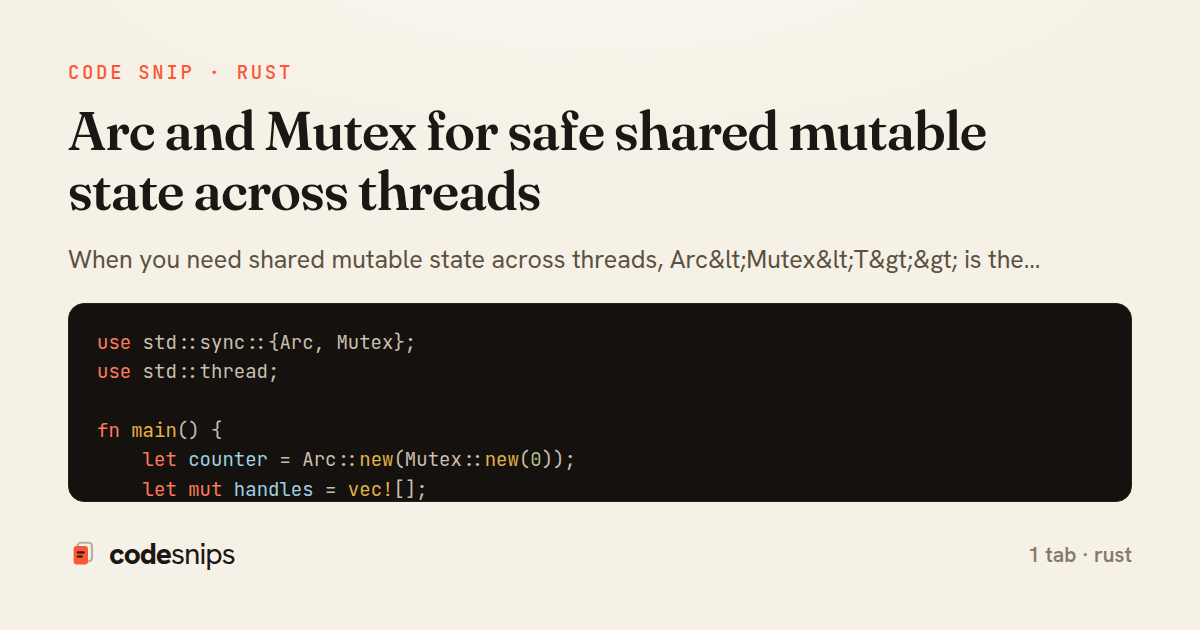
When you need shared mutable state across threads, Arc<Mutex<T>> is the idiomatic pattern. Arc is an atomic reference counter that allows multiple ownership, and Mutex provides interior mutability with runtime locking. You clone the Arc for each thread, giving them all access to the same Mutex. Locking the mutex returns a guard that automatically unlocks on drop, preventing deadlocks from forgotten unlocks. The compiler ensures you can't access the data without locking. This pattern is slower than lock-free alternatives but far safer than raw pointers or C-style mutexes. For read-heavy workloads, I use RwLock instead. The key is that Rust makes shared mutability explicit and safe by default.
Related snips
rust
struct Config<'a> {
    name: &'a str,
    value: &'a str,
}

fn parse_config(line: &str) -> Config {
Lifetime annotations for flexible borrowing in structs
rust
lifetimes
borrowing
by Marcus Chen
1 tab
javascript
// Creating a Promise
const myPromise = new Promise((resolve, reject) => {
  const success = true;

  setTimeout(() => {
    if (success) {
Promises and async/await patterns for asynchronous JavaScript
javascript
promises
async-await
by Alex Chang
1 tab
rust
use crossbeam::channel::unbounded;
use std::thread;

fn main() {
    let (tx, rx) = unbounded();
Crossbeam for advanced concurrent data structures
rust
concurrency
lock-free
by Marcus Chen
1 tab
rust
use tracing::{info, instrument};

#[instrument]
fn process_request(user_id: u64) {
    info!(user_id, "Processing request");
    // Work happens here
tracing for structured logging and distributed tracing
rust
observability
tracing
by Marcus Chen
1 tab
rust
use std::sync::mpsc;
use std::thread;

fn main() {
    let (tx, rx) = mpsc::channel();
Channels (mpsc) for message passing between threads
rust
concurrency
channels
by Marcus Chen
1 tab
rust
use clap::Parser;

#[derive(Parser, Debug)]
#[command(author, version, about)]
struct Args {
    #[arg(short, long)]
clap for CLI argument parsing with derive macros
rust
cli
clap
by Marcus Chen
1 tab
Share this code
Here's the card — post it anywhere.