rust
18 lines · 1 tab
Marcus Chen
Jan 2026
1 tab
use reqwest;
use serde::Deserialize;

#[derive(Deserialize, Debug)]
struct Post {
    id: u32,
    title: String,
}

#[tokio::main]
async fn main() -> Result<(), reqwest::Error> {
    let post: Post = reqwest::get("https://jsonplaceholder.typicode.com/posts/1")
        .await?
        .json()
        .await?;
    println!("{:?}", post);
    Ok(())
}
1 file · rust
Explain with highlit
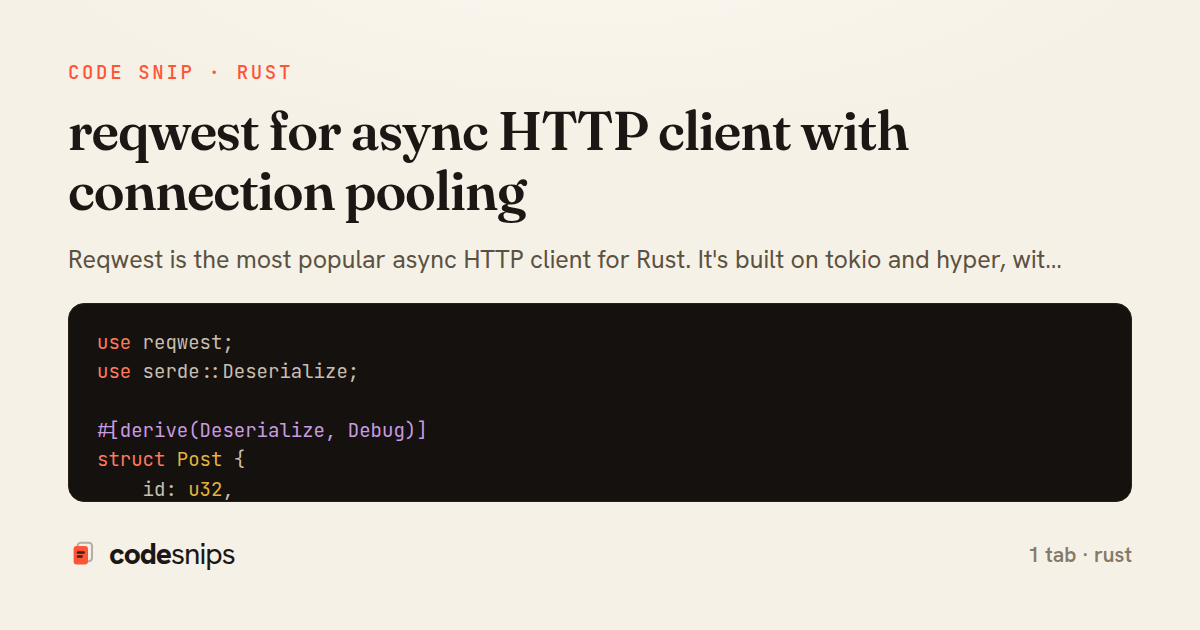
Reqwest is the most popular async HTTP client for Rust. It's built on tokio and hyper, with a high-level API for making requests. Connection pooling, redirects, timeouts, and TLS are handled automatically. I use the builder pattern to configure clients, and the ? operator with anyhow for error handling. For JSON APIs, .json() deserializes directly into your serde types. The client is Clone and internally uses an Arc, so you can share it across tasks cheaply. For retries, rate limiting, or custom middleware, I wrap it in a service struct. Reqwest strikes a good balance between convenience and performance, and it's battle-tested in production at scale.
Related snips
typescript
export interface RetryOptions {
  retries: number;
  baseMs: number;
  maxMs: number;
  signal?: AbortSignal;
  onRetry?: (attempt: number, delay: number, err: unknown) => void;
Exponential backoff with jitter for retries
typescript
reliability
retry
by codesnips
2 tabs
rust
struct Config<'a> {
    name: &'a str,
    value: &'a str,
}

fn parse_config(line: &str) -> Config {
Lifetime annotations for flexible borrowing in structs
rust
lifetimes
borrowing
by Marcus Chen
1 tab
javascript
// Creating a Promise
const myPromise = new Promise((resolve, reject) => {
  const success = true;

  setTimeout(() => {
    if (success) {
Promises and async/await patterns for asynchronous JavaScript
javascript
promises
async-await
by Alex Chang
1 tab
rust
use crossbeam::channel::unbounded;
use std::thread;

fn main() {
    let (tx, rx) = unbounded();
Crossbeam for advanced concurrent data structures
rust
concurrency
lock-free
by Marcus Chen
1 tab
rust
use tracing::{info, instrument};

#[instrument]
fn process_request(user_id: u64) {
    info!(user_id, "Processing request");
    // Work happens here
tracing for structured logging and distributed tracing
rust
observability
tracing
by Marcus Chen
1 tab
rust
use std::sync::mpsc;
use std::thread;

fn main() {
    let (tx, rx) = mpsc::channel();
Channels (mpsc) for message passing between threads
rust
concurrency
channels
by Marcus Chen
1 tab
Share this code
Here's the card — post it anywhere.