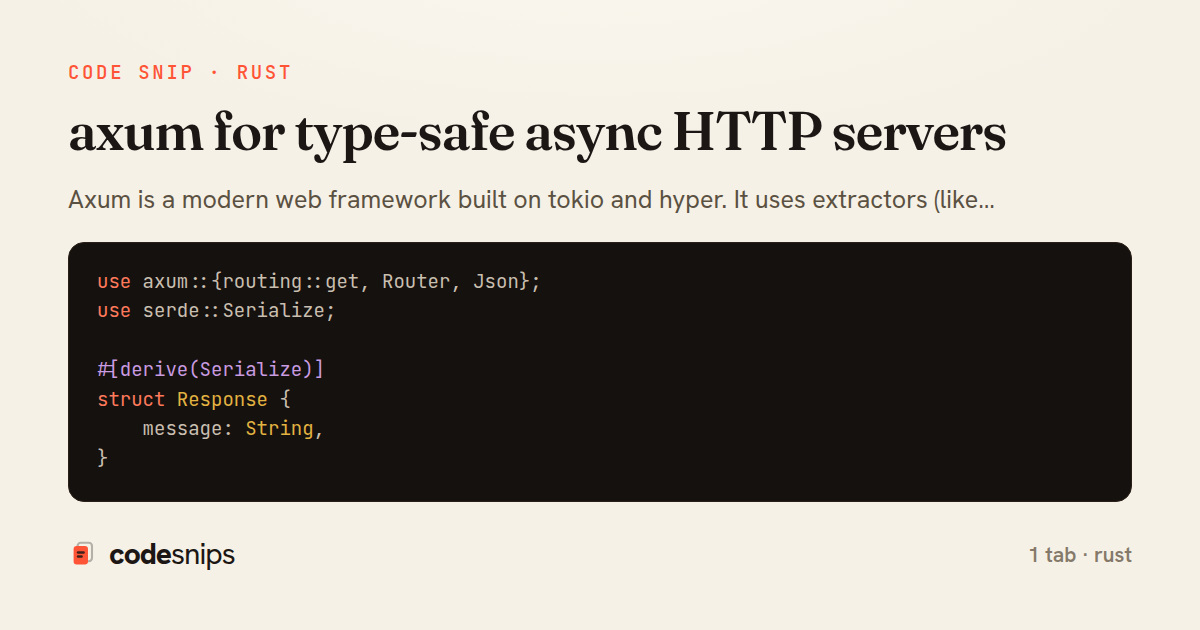
use axum::{routing::get, Router, Json};
use serde::Serialize;

#[derive(Serialize)]
struct Response {
    message: String,
}

async fn handler() -> Json<Response> {
    Json(Response { message: "Hello, axum!".into() })
}

#[tokio::main]
async fn main() {
    let app = Router::new().route("/", get(handler));
    axum::Server::bind(&"0.0.0.0:3000".parse().unwrap())
        .serve(app.into_make_service())
        .await
        .unwrap();
}
Axum is a modern web framework built on tokio and hyper. It uses extractors (like Json<T>, Path<T>, State<S>) to parse requests into Rust types, and the compiler ensures your handlers match their routes. Middleware is just functions, making it easy to compose. I like axum because it's minimalist but ergonomic: no macros, just traits and async functions. The Router API is clean, and integration with tower services gives you battle-tested middleware (tracing, timeouts, rate limiting). For APIs, I define request/response types as structs, and axum handles serialization with serde_json. It's my go-to for building production HTTP services in Rust because the type safety catches bugs early and the performance is excellent.
Related snips
export interface RetryOptions {
  retries: number;
  baseMs: number;
  maxMs: number;
  signal?: AbortSignal;
  onRetry?: (attempt: number, delay: number, err: unknown) => void;
Exponential backoff with jitter for retries
struct Config<'a> {
    name: &'a str,
    value: &'a str,
}

fn parse_config(line: &str) -> Config {
Lifetime annotations for flexible borrowing in structs
// Creating a Promise
const myPromise = new Promise((resolve, reject) => {
  const success = true;

  setTimeout(() => {
    if (success) {
Promises and async/await patterns for asynchronous JavaScript
use crossbeam::channel::unbounded;
use std::thread;

fn main() {
    let (tx, rx) = unbounded();
Crossbeam for advanced concurrent data structures
use tracing::{info, instrument};

#[instrument]
fn process_request(user_id: u64) {
    info!(user_id, "Processing request");
    // Work happens here
tracing for structured logging and distributed tracing
use std::sync::mpsc;
use std::thread;

fn main() {
    let (tx, rx) = mpsc::channel();
Channels (mpsc) for message passing between threads
Share this code
Here's the card — post it anywhere.