rust
19 lines · 1 tab
Marcus Chen
Jan 2026
1 tab
use axum::{Router, routing::get};
use tower::ServiceBuilder;
use tower_http::{trace::TraceLayer, timeout::TimeoutLayer};
use std::time::Duration;

async fn handler() -> &'static str {
    "Hello"
}

#[tokio::main]
async fn main() {
    let app = Router::new()
        .route("/", get(handler))
        .layer(
            ServiceBuilder::new()
                .layer(TraceLayer::new_for_http())
                .layer(TimeoutLayer::new(Duration::from_secs(10)))
        );
}
1 file · rust
Explain with highlit
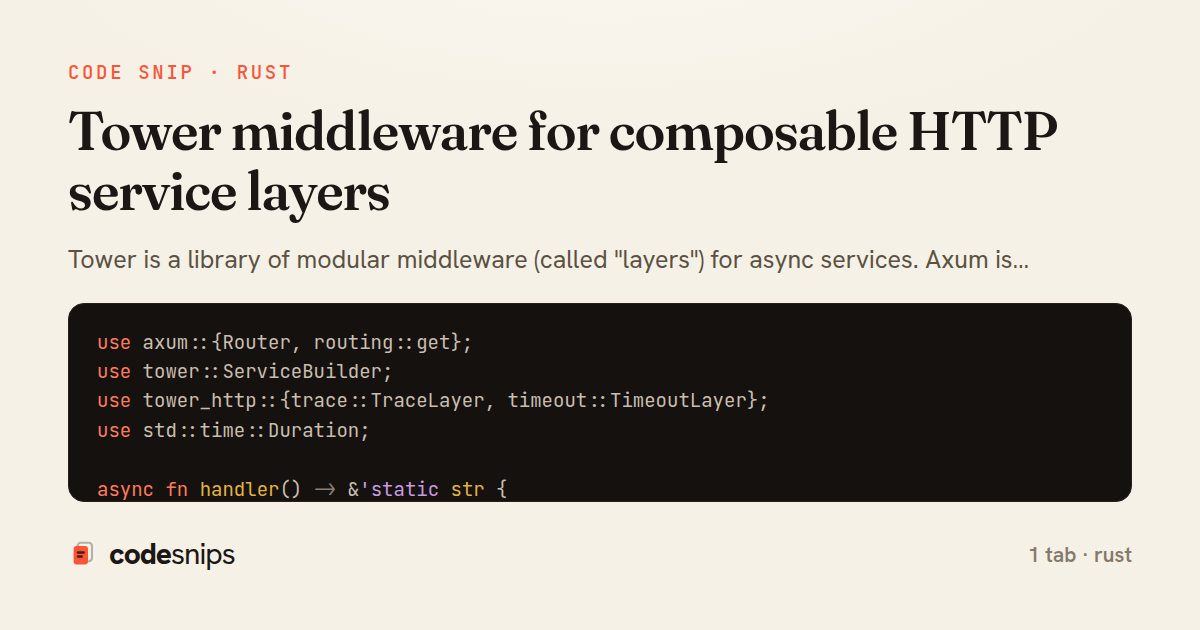
Tower is a library of modular middleware (called "layers") for async services. Axum is built on Tower, so you can use any Tower middleware: TimeoutLayer, CompressionLayer, TraceLayer, etc. Layers wrap services, adding behavior like logging, metrics, or retries. The ServiceBuilder API chains layers in the order they're applied. I use tower-http for common HTTP concerns and write custom layers for domain-specific logic (auth, rate limiting). The beauty is that layers are decoupled from the framework: you can test them in isolation and reuse them across different servers. This composability is a key strength of the Rust async ecosystem.
Related snips
typescript
export interface RetryOptions {
  retries: number;
  baseMs: number;
  maxMs: number;
  signal?: AbortSignal;
  onRetry?: (attempt: number, delay: number, err: unknown) => void;
Exponential backoff with jitter for retries
typescript
reliability
retry
by codesnips
2 tabs
rust
struct Config<'a> {
    name: &'a str,
    value: &'a str,
}

fn parse_config(line: &str) -> Config {
Lifetime annotations for flexible borrowing in structs
rust
lifetimes
borrowing
by Marcus Chen
1 tab
rust
use crossbeam::channel::unbounded;
use std::thread;

fn main() {
    let (tx, rx) = unbounded();
Crossbeam for advanced concurrent data structures
rust
concurrency
lock-free
by Marcus Chen
1 tab
rust
use tracing::{info, instrument};

#[instrument]
fn process_request(user_id: u64) {
    info!(user_id, "Processing request");
    // Work happens here
tracing for structured logging and distributed tracing
rust
observability
tracing
by Marcus Chen
1 tab
rust
use std::sync::mpsc;
use std::thread;

fn main() {
    let (tx, rx) = mpsc::channel();
Channels (mpsc) for message passing between threads
rust
concurrency
channels
by Marcus Chen
1 tab
rust
use clap::Parser;

#[derive(Parser, Debug)]
#[command(author, version, about)]
struct Args {
    #[arg(short, long)]
clap for CLI argument parsing with derive macros
rust
cli
clap
by Marcus Chen
1 tab
Share this code
Here's the card — post it anywhere.