rust
12 lines · 1 tab
Marcus Chen
Jan 2026
1 tab
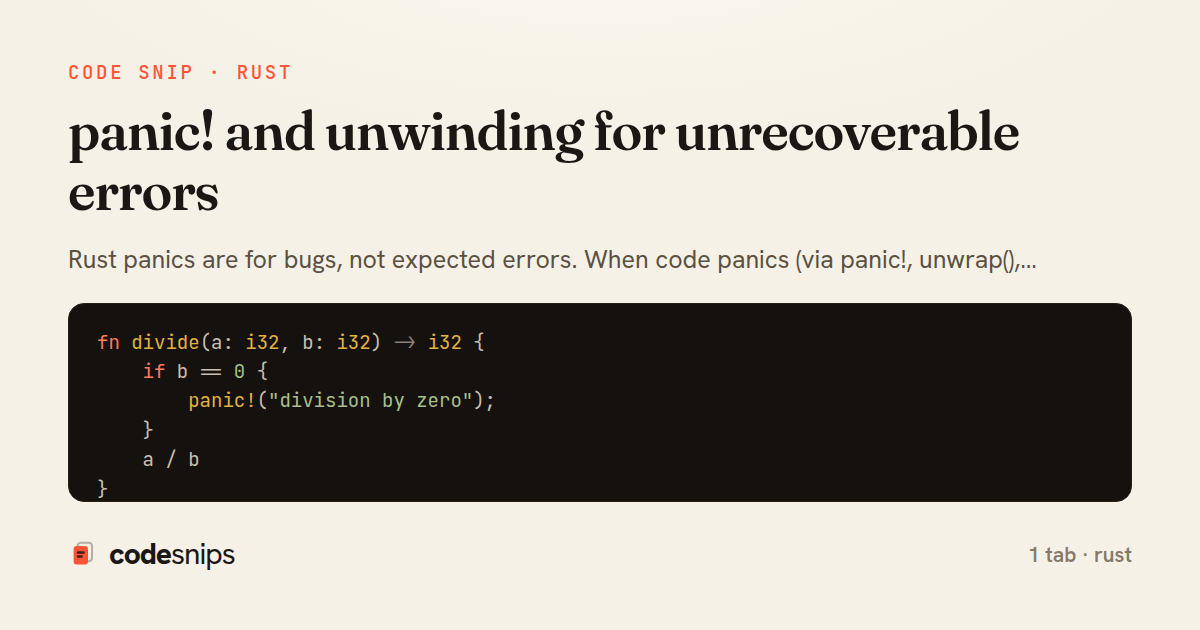
fn divide(a: i32, b: i32) -> i32 {
    if b == 0 {
        panic!("division by zero");
    }
    a / b
}

fn main() {
    let result = divide(10, 2);
    println!("Result: {}", result);
    // divide(10, 0); // This would panic
}
1 file · rust
Explain with highlit
Rust panics are for bugs, not expected errors. When code panics (via panic!, unwrap(), expect(), or assertion failure), the thread unwinds by default, running destructors. I use panic! for invariant violations or \"this should never happen\" cases. For production, set panic = 'abort' in Cargo.toml to skip unwinding and reduce binary size. Panics can be caught with std::panic::catch_unwind, but this is rare; Rust prefers Result for recoverable errors. I reserve panics for programming errors and use Result for runtime errors. The key is intentionality: panics mean \"the program state is corrupt,\" while Result means \"this operation might fail normally.\"
Related snips
rust
struct Config<'a> {
    name: &'a str,
    value: &'a str,
}

fn parse_config(line: &str) -> Config {
Lifetime annotations for flexible borrowing in structs
rust
lifetimes
borrowing
by Marcus Chen
1 tab
javascript
// Creating a Promise
const myPromise = new Promise((resolve, reject) => {
  const success = true;

  setTimeout(() => {
    if (success) {
Promises and async/await patterns for asynchronous JavaScript
javascript
promises
async-await
by Alex Chang
1 tab
rust
use crossbeam::channel::unbounded;
use std::thread;

fn main() {
    let (tx, rx) = unbounded();
Crossbeam for advanced concurrent data structures
rust
concurrency
lock-free
by Marcus Chen
1 tab
rust
use tracing::{info, instrument};

#[instrument]
fn process_request(user_id: u64) {
    info!(user_id, "Processing request");
    // Work happens here
tracing for structured logging and distributed tracing
rust
observability
tracing
by Marcus Chen
1 tab
rust
use std::sync::mpsc;
use std::thread;

fn main() {
    let (tx, rx) = mpsc::channel();
Channels (mpsc) for message passing between threads
rust
concurrency
channels
by Marcus Chen
1 tab
rust
use clap::Parser;

#[derive(Parser, Debug)]
#[command(author, version, about)]
struct Args {
    #[arg(short, long)]
clap for CLI argument parsing with derive macros
rust
cli
clap
by Marcus Chen
1 tab
Share this code
Here's the card — post it anywhere.